
How Subscription Models Benefit from Loyalty Programs
How Subscription Models Benefit from Loyalty Programs
Subscriptions thrive on retention, and loyalty programs are the key to keeping customers engaged. With acquisition costs up 222% in the last decade, retaining subscribers is more affordable and impactful than constantly chasing new ones. Here's why loyalty programs work so well for subscription businesses:
- Higher Lifetime Value: Subscribers engaging with loyalty programs see up to an 88% boost in lifetime value.
- Reduced Churn: Loyalty programs cut customer churn by 37%, ensuring more predictable revenue.
- Increased Spending: Members of paid loyalty programs spend 15–25% more annually than non-members.
- Stronger Engagement: Programs offering perks like points, rewards, and exclusive benefits encourage customers to stay longer.
Amazon Prime, Costco, and Sephora are prime examples of how loyalty initiatives drive retention and revenue. Whether through personalized perks, gamification, or exclusive access, loyalty programs transform subscriptions into experiences customers want to stick with. By combining recurring payments with emotional incentives, businesses can increase retention and maximize profits.
How to Maximise Retention Through Loyalty
Retention Challenges in Subscription Businesses
Subscription businesses are grappling with growing hurdles, especially as customer acquisition costs (CAC) have skyrocketed by 222% over the past decade. This steep rise means acquiring new customers is now more than twice as expensive as it was ten years ago. As a result, businesses are under immense pressure to retain their existing subscribers and maximize their value.
High Churn Rates and Their Impact
Churn is costly. When a subscriber cancels, you lose not just their current payment but all the revenue you were counting on from future renewals. And here's why that hurts even more: existing customers spend up to 67% more per purchase than new ones. Steve Hutt, author of eCommerce Fastlane, emphasizes:
"Existing customers are not only easier (and 6 to 7 times cheaper) to sell to than first-time browsers, but they also spend up to 67% more per purchase".
One of the primary reasons for churn is a lack of perceived value. If a subscription is built solely around discounts without offering a deeper connection or a more engaging membership experience, customers are quick to leave. Jenna Post Crokin from Smartrr puts it bluntly: "If the discount disappeared, would people still subscribe? If the answer is no, it's time to rethink your strategy".
Another major factor driving churn is friction. A staggering 70% of shoppers abandon their checkout if the process feels cumbersome. Similarly, if managing a subscription or redeeming rewards becomes a hassle, customers are more likely to disengage and eventually cancel.
Low Customer Lifetime Value (CLV)
Low customer lifetime value (CLV) is another thorn in the side of subscription businesses. Many customers sign up for the initial discount, only to cancel shortly after, preventing businesses from building long-term value. Yet, the numbers show the potential: subscribers have a 185% higher CLV compared to one-time buyers. And when those subscribers actively engage with loyalty programs - redeeming points or making referrals - their CLV increases by an additional 88%.
CLV depends on retention rates, average revenue per user, and how long customers stick around. With CAC on the rise and profit margins shrinking, businesses need to focus on keeping customers longer, encouraging them to spend more, and turning them into loyal advocates. Addressing these retention challenges is crucial for driving sustained growth and profitability.
How Loyalty Programs Address Retention Problems
Loyalty programs tackle retention issues by creating stronger connections between brands and customers while offering consistent value. This approach makes continuing a subscription the logical choice for customers.
Increasing Customer Engagement
Loyalty programs encourage ongoing participation by providing immediate perks rather than requiring customers to wait for rewards based on points. Programs with upfront membership fees often see much higher renewal rates - ranging from 70% to 90% - compared to the 40% to 60% seen in free programs. This financial commitment fosters a sense of loyalty and drives customer behavior.
Take Amazon Prime as an example. By February 2026, it had over 200 million subscribers globally, boasting a renewal rate of about 93%. Prime contributes an estimated 35% of Amazon’s total sales, thanks to its simple sign-up process and valuable benefits like free shipping, streaming services, and exclusive deals.
Additionally, subscription loyalty programs have a proven financial impact. Members typically spend 15% to 25% more annually than non-members. For instance, Sephora reports that customers in its paid-tier loyalty program are up to four times more valuable than those in its free tier. Brands with subscription-based loyalty models also see about 30% more customer interaction than traditional models. This increased engagement naturally leads to stronger retention and more consistent revenue streams.
Improving Retention Rates and Revenue Predictability
Loyalty programs are particularly effective at reducing churn and stabilizing revenue. On average, these programs cut customer churn by 37%. Members are also 45% more likely to make a second purchase compared to the industry average of 20%. This reduction in churn significantly enhances Customer Lifetime Value (CLV) - a key indicator of subscription success. In fact, subscription members can generate up to 70% higher CLV compared to non-subscription customers.
The financial benefits are clear. Costco, for example, maintains renewal rates exceeding 90% by offering bulk pricing and exclusive products for a $60 annual fee. Members end up spending far more than non-members. As Alexandra P. from Enable3 explains:
"Once people invest financially, they're more committed to getting value from it. That commitment drives behavior".
Loyalty programs also address both intentional and passive churn. For customers who actively consider canceling, options like "pause" or "skip" features - tailored to their feedback - can help retain them. Meanwhile, for passive churn caused by failed payments, automated retry systems integrated into subscription platforms ensure revenue keeps flowing.
Personalization and Data-Driven Insights
Personalization is another key factor in building loyalty. These programs gather data to offer tailored experiences, which significantly enhance satisfaction and retention. Research shows that 80% of consumers are more likely to buy from brands offering personalized experiences, and 90% prefer brands that recognize them by name and provide custom promotions. Using tools like RFM analysis (Recency, Frequency, and Monetary value), businesses can segment customers, identifying loyal high-spenders and those at risk of leaving. Automated systems can then step in - sending personalized rewards or re-engagement offers when customers hit milestones or show signs of disengagement.
A great example is Pret A Manger’s coffee subscription, powered by Eagle Eye. This program uses real-time data and behavioral insights to deliver personalized, seamless experiences for members. When implemented effectively, subscription loyalty models can boost customer lifetime value by up to 300%. As Andrii N. from Enable3 puts it:
"The brands that win long-term aren't chasing conversions. They're investing in continuity".
Free vs. Paid Loyalty Programs: Key Differences
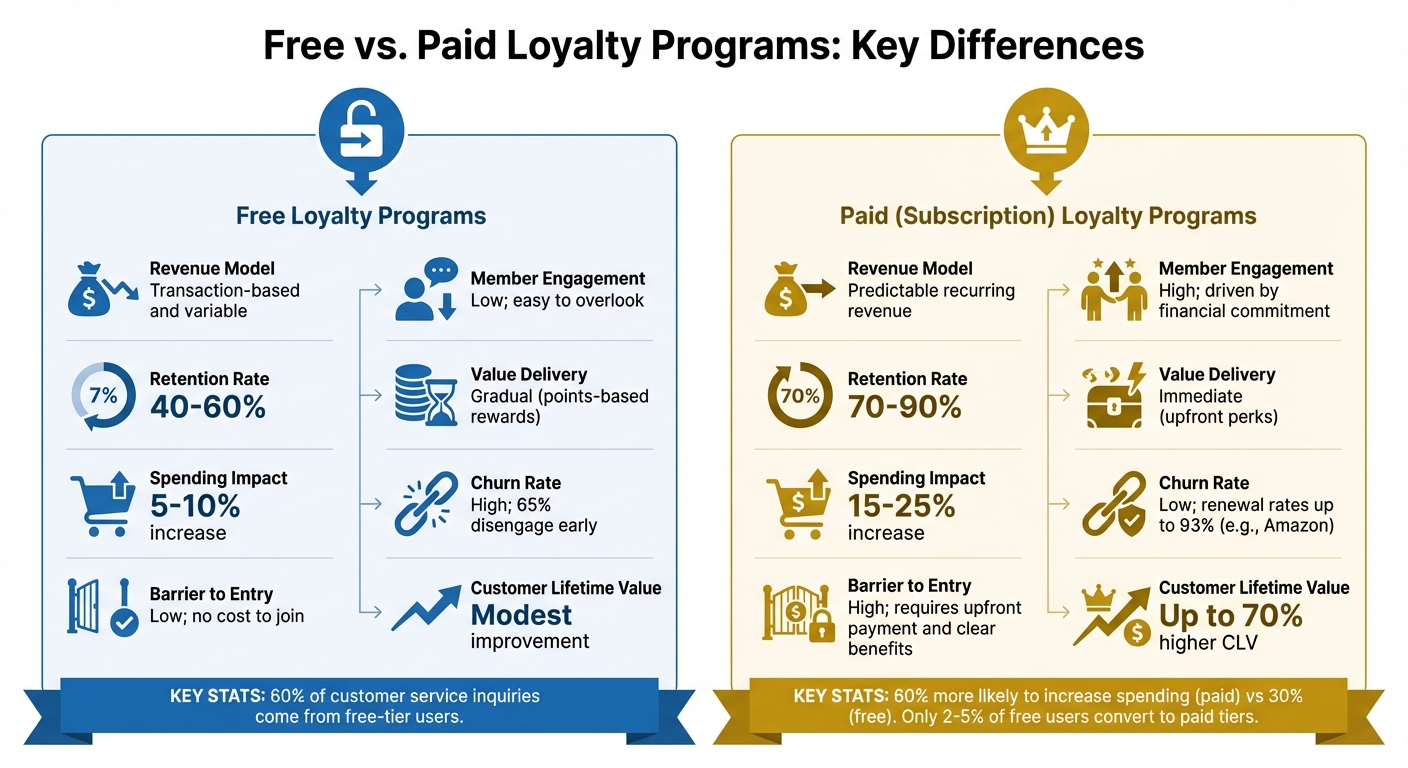
Free vs Paid Loyalty Programs: Key Metrics Comparison
Choosing between free and paid loyalty programs depends on how each model influences customer behavior. Free programs are great for attracting users quickly since they have no upfront costs, making them easy to join. But keeping those users engaged is a challenge - about 65% of users in free programs lose interest after signing up. On the other hand, paid programs rely on a psychological principle called the "sunk cost effect." When customers pay a membership fee, they’re more likely to stick around and use the benefits to make their investment worthwhile.
The financial outcomes of these models are quite different. Paid loyalty program members are 60% more likely to increase their spending compared to only 30% for free program members. Take Amazon Prime, for example: its paid membership structure drives significantly higher lifetime customer value.
How these programs deliver value also sets them apart. Free programs typically reward customers gradually, while paid programs offer immediate perks. A good example is CVS CarePass, which charges $5 per month but delivers $10 in monthly promo rewards, 20% off CVS Health products, and free shipping.
"When your customer has already paid that subscription fee, they're psychologically motivated to get their money's worth - which means they shop more, engage more, and stick around longer."
– Happy Rewards
Operationally, the two models come with distinct trade-offs. Free programs may attract a larger user base initially, but they also demand more resources - 60% of customer service inquiries often come from free-tier users. Paid programs, while requiring robust billing systems and continuous updates to benefits, provide predictable recurring revenue and higher retention rates, ranging from 70% to 90%, compared to 40% to 60% for free programs. However, converting free users to paid tiers remains a tough challenge, with only 2% to 5% typically making the switch.
Comparison Table: Free vs. Paid Loyalty Programs
Here’s a closer look at how free and paid loyalty programs stack up across various factors:
| Aspect | Free Loyalty Programs | Paid (Subscription) Loyalty Programs |
|---|---|---|
| Revenue Model | Transaction-based and variable | Predictable recurring revenue |
| Member Engagement | Low; easy to overlook | High; driven by financial commitment |
| Retention Rate | 40–60% | 70–90% |
| Value Delivery | Gradual (points-based rewards) | Immediate (upfront perks) |
| Spending Impact | 5–10% increase | 15–25% increase |
| Churn Rate | High; 65% disengage early | Low; renewal rates up to 93% (e.g., Amazon) |
| Barrier to Entry | Low; no cost to join | High; requires upfront payment and clear benefits |
| Customer Lifetime Value | Modest improvement | Up to 70% higher CLV |
Examples of Loyalty Programs in Subscription Models
Amazon Prime: Engagement Through Exclusive Benefits
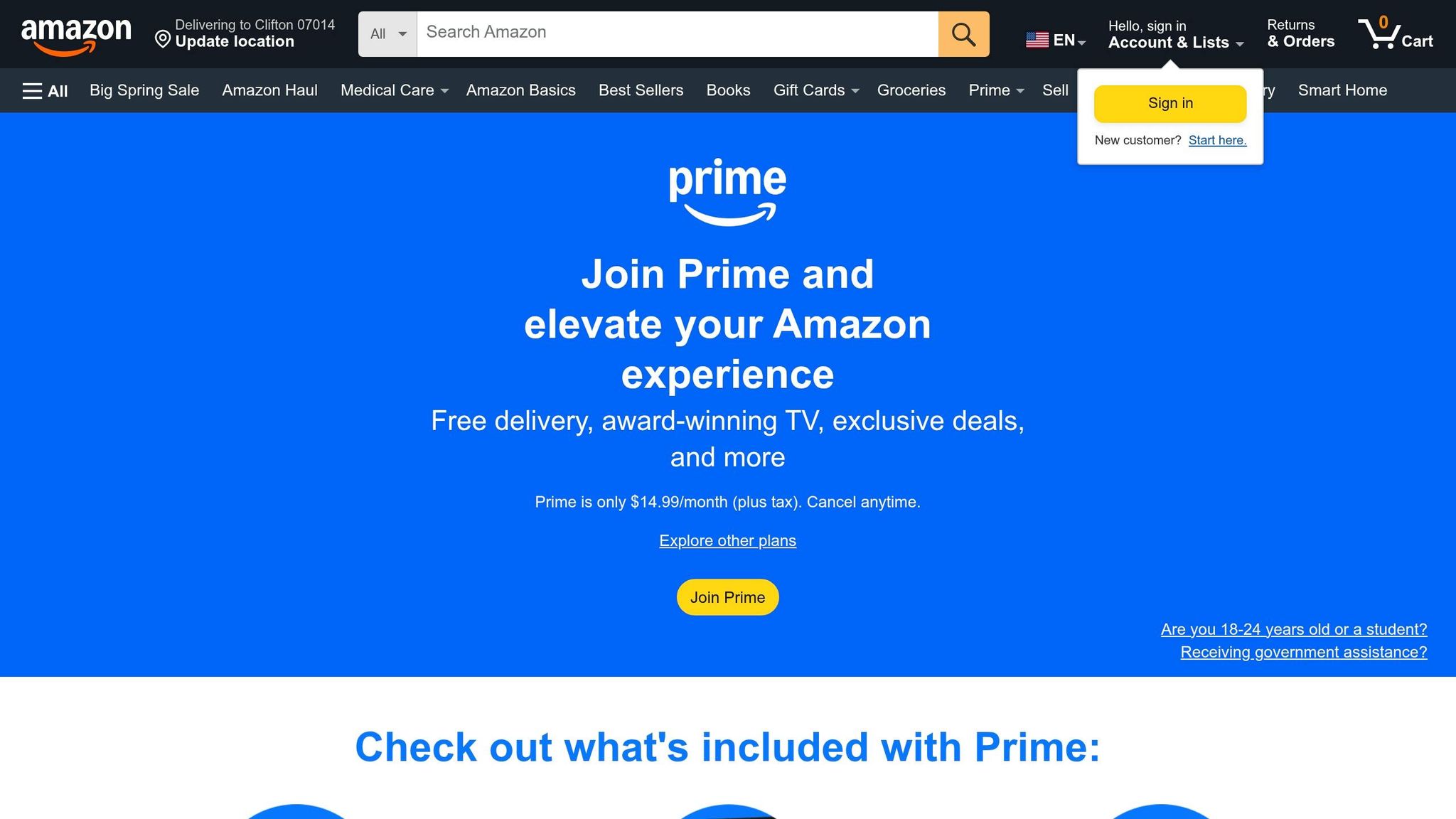
Amazon Prime has become a gold standard in subscription loyalty programs, boasting over 200 million subscribers globally. On average, Prime members spend $1,500 annually, compared to $625 by non-members.
What makes this program so effective is its ecosystem approach. It bundles perks like fast shipping, streaming services, music, gaming benefits, and AI tools into one membership. In 2024, under Moz Thomas, Director of Worldwide Amazon Prime Benefits, the program introduced even more value. Members gained access to fuel discounts at thousands of U.S. gas stations - saving up to $70 annually - and received the $20/month Alexa+ AI service as a free benefit. These additions helped Amazon deliver a record 9 billion items to Prime members in 2024, contributing to approximately $44 billion in subscription revenue.
"The key goal I have is to make Prime so valuable, you'd be irresponsible not to have it." – Jeff Bezos, Founder, Amazon
At $14.99/month or $139/year, the program taps into the endowment effect. Once members commit to the upfront cost, they feel driven to maximize the benefits, which leads to impressive retention rates and increased spending.
While Amazon Prime excels with its all-encompassing ecosystem, other companies take a simpler, savings-oriented route to loyalty.
Barnes & Noble Membership: Savings-Based Retention
Barnes & Noble’s Premium Membership, priced at $39.99 per year, takes a more straightforward approach by focusing on immediate monetary savings rather than bundling a wide range of services. Members enjoy a 10% discount on all purchases - whether in-store, online, or at Paper Source - and free shipping on every order.
This model is effective at building loyalty. The membership also includes a rewards system where members earn a $5 reward for every 10 stamps they collect. Additional perks like one free eBook per month, café drink upgrades, and early access to special editions add a layer of exclusivity.
"The real value lies in the combination of monetary savings and exclusive experiences." – Zsuzsanna Ban, Loyalty Specialist, Antavo
This strategy appeals to avid readers who can easily measure their savings. For frequent customers, the annual fee quickly feels worthwhile after just a few purchases, reinforcing their loyalty to the brand.
Implementing a Loyalty Program in Your Subscription Model
Designing and Launching the Program
Before rolling out a loyalty program, it's essential to establish clear and measurable goals. For instance, you might aim to boost retention by 20%, shift 15% of revenue to recurring fees, or hit a renewal rate of 80% or more. These targets act as benchmarks to track your program's progress over time.
Start by segmenting your audience into three key groups: potential converts (regular non-subscribers), churned customers, and "at-risk" subscribers who have paused their memberships. Use customer surveys and behavioral data to pinpoint what motivates each group - whether that's free shipping, exclusive product access, or time-saving benefits.
Next, select a program model that aligns with your business. You could opt for membership clubs with a flat fee for ongoing perks (like Amazon Prime's $139/year), tiered programs with escalating benefits based on spending levels, or hybrid models that combine free entry with paid upgrades. Keep in mind that your profit margins - ideally 30% or higher - should be able to support the perks you offer.
Structure your program to provide both immediate and long-term benefits. For example, offer perks like free shipping upfront, followed by rewards such as access to exclusive events over time. Ensure your digital tools can handle seamless billing, personalization, and predictive analytics to identify churn risks early. Additionally, make sure your loyalty platform integrates well with existing systems like Shopify for e-commerce or Klaviyo for marketing automation.
Pricing is another critical factor. Test your pricing to ensure customers see clear value. Take Amazon Prime, for example - its $139/year fee works because members use the service often enough to justify the cost. If your top 20% of buyers contribute 40% or more of your revenue, your business is likely ready for a subscription-based loyalty model.
Once your program is designed, the next step is keeping members engaged with creative rewards and feedback mechanisms.
Driving Engagement with Rewards and Feedback Loops
To maintain member interest, implement tiered reward structures. Offering VIP levels with higher-value perks - like double points or free shipping - encourages long-term loyalty. Data shows members who redeem personalized rewards spend 4.3 times more annually than those who redeem generic offers.
Gamification is another way to drive engagement. Award points for actions beyond purchases, such as writing product reviews, referring friends, or sharing on social media. With the average U.S. consumer enrolled in 16.6 loyalty programs but actively engaging with only half, your program needs to stand out by delivering rewards that feel tailored and meaningful.
Go beyond discounts to build emotional connections. Offer exclusive content, early access to new products, or member-only events. Interestingly, one in four consumers is willing to pay more for brands that show ethical values, such as letting members donate loyalty points to charitable causes. These efforts not only enhance brand perception but also deepen customer loyalty.
Give your most loyal members early access to new products or free samples in exchange for feedback. This approach creates a valuable feedback loop, helping you refine your offerings while making members feel appreciated. For churned customers, consider win-back rewards like a free product or a discounted first month to reengage them.
Finally, continuously improve your program based on participation data and customer feedback. Use surveys to identify underperforming rewards and make adjustments as needed. Automate payment recovery with reminders and retry systems - since 7% of payments fail initially. Addressing these small friction points can significantly reduce involuntary churn and keep your subscribers engaged for the long haul.
Conclusion
Loyalty programs are a natural fit with subscription models, offering a way to deepen customer connections and enhance lifetime value. Subscriptions simplify the buying process, while loyalty programs provide the emotional pull that keeps customers engaged over time. As Jenna Post Crokin from Smartrr explains, combining these two strategies creates a winning formula for increasing customer lifetime value.
The numbers speak for themselves: a subscriber’s lifetime value is 185% higher than that of a one-time purchaser. Add a loyalty program to the mix, and that value jumps another 88%. With customer acquisition costs now 222% higher than they were ten years ago, focusing on retaining existing customers through loyalty initiatives is not just smart - it’s essential for long-term growth.
But it’s not just about offering discounts. The best programs create a sense of belonging, using tools like tiered rewards, gamification, exclusive perks, and personalized experiences to make customers feel appreciated. By analyzing behavioral data, you can even predict churn and deliver well-timed rewards to keep subscribers engaged and loyal.
The goal is to create a seamless, integrated experience that makes retention effortless. Whether you’re starting fresh or refining an existing program, prioritize smooth integration between your subscription and loyalty platforms. Automate reward redemptions and use data insights to continuously improve. After all, even a modest 5% boost in retention can drive profits up by as much as 95%.
FAQs
How do I choose between a free or paid loyalty program for my subscription?
Choosing between a free or paid loyalty program comes down to your business goals and how you plan to engage with your customers. Free programs work well if you're looking to expand your customer base quickly since they’re easy for people to join. On the other hand, paid programs tend to encourage higher spending and build stronger loyalty by offering exclusive perks. Think about where your business stands, who your audience is, and what resources you have - or consider hybrid models to strike a balance between the two.
What rewards actually reduce churn without hurting profit margins?
Rewards designed to focus on long-term customers and offer exclusive benefits - like personalized experiences and customized content - are a smart way to lower churn rates. These approaches not only build loyalty but also keep profit margins intact, ensuring a balance between customer retention and financial health.
What metrics should I track to prove a loyalty program is working?
To gauge how well a loyalty program is performing, focus on tracking a few critical metrics. Start with the customer retention rate, which shows how successful you are at keeping customers coming back. Next, monitor customer lifetime value (CLV) to understand the total revenue a customer generates over their relationship with your business. Pay attention to engagement levels, as they reveal how actively customers are participating in the program. Lastly, look at the frequency of customer interactions, which can indicate how often customers are engaging with your brand. Together, these metrics provide a clear picture of the program's impact on loyalty and long-term growth.