
Dynamic Pricing Do's and Don'ts for SaaS
Dynamic Pricing Do's and Don'ts for SaaS
Dynamic pricing is transforming how SaaS companies set subscription fees. By using real-time data and AI, businesses can adjust pricing based on usage, market trends, and customer behavior. This approach can boost revenue by 15–25%, reduce churn by 22%, and improve monetization efficiency by 18%. Here's a quick overview of what works and what to avoid:
Key Takeaways:
-
Do's:
- Use measurable value metrics like API calls or tokens.
- Combine subscription fees with usage-based billing for flexibility.
- Leverage AI for personalized pricing and better customer targeting.
- Adjust pricing by geography to reflect local purchasing power.
- Focus on transparency to maintain customer trust.
-
Don'ts:
- Avoid pricing too low; it can hurt profitability and customer perception.
- Keep pricing simple - overcomplex models can confuse customers.
- Communicate pricing changes clearly to prevent backlash.
- Don't ignore compliance or market segmentation rules.
Dynamic pricing is most effective when aligned with customer value, supported by proper tools, and implemented with clear communication. Start small, test thoroughly, and refine regularly to ensure success.
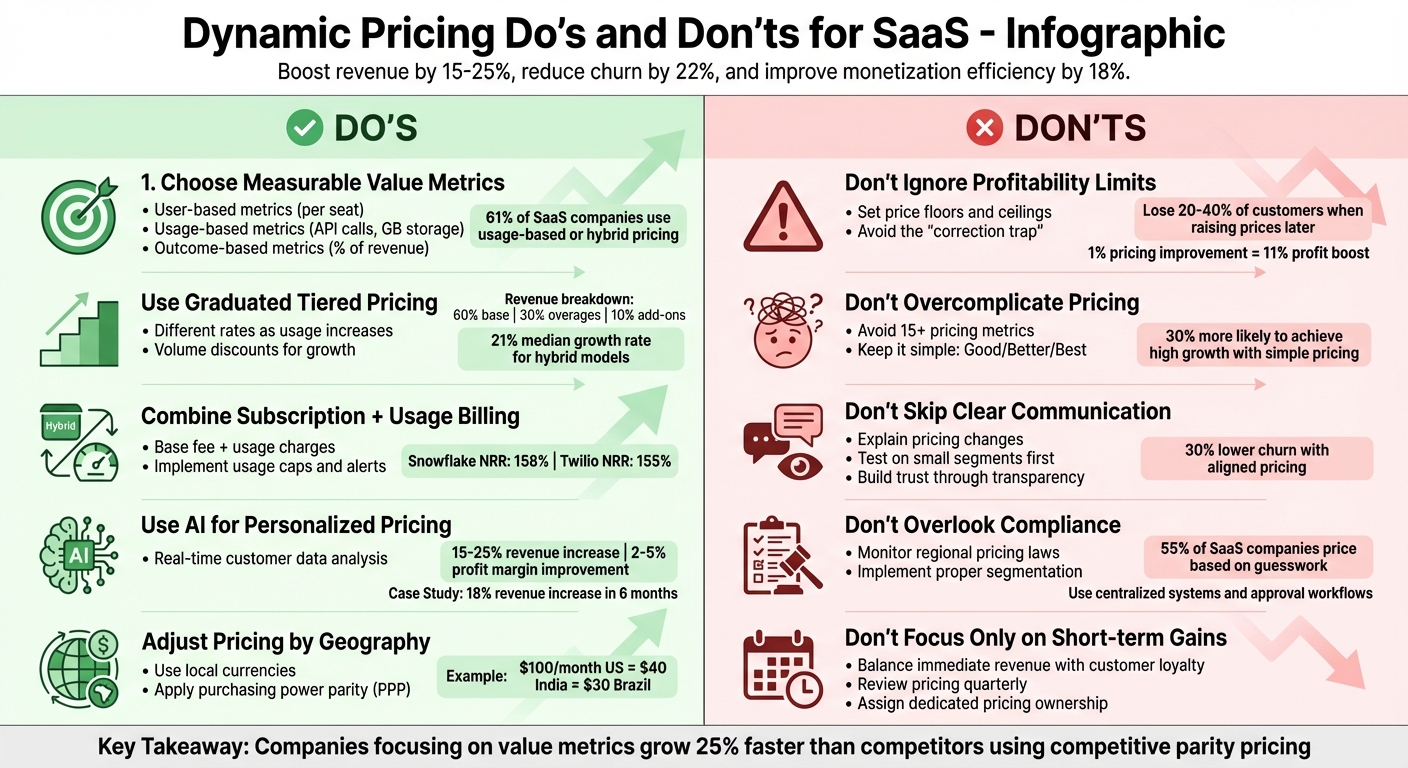
Dynamic Pricing Do's and Don'ts for SaaS Companies
Do's of Dynamic Pricing for SaaS
Choose Measurable Value Metrics
At the heart of effective dynamic pricing lies the choice of a value metric - the unit that determines what customers pay. This metric should align with how customers achieve success, scale as they grow, and remain simple to measure.
For example, user-based metrics (like charging per seat) work well for tools like CRMs and collaboration platforms because they’re predictable and easy to forecast. On the other hand, usage-based metrics - such as API calls, data storage (measured in GB), or transactions - scale naturally with customer success and lower the entry barrier. Outcome-based metrics, like charging a percentage of revenue or per lead generated, offer strong value alignment but can be trickier to attribute.
For AI-focused products, traditional per-seat pricing often doesn’t fit since value doesn’t scale with headcount. Instead, metrics like tokens processed, model calls, or compute seconds are now common. In fact, 61% of SaaS companies now use some form of usage-based or hybrid pricing, up from 49% the previous year.
"The right SaaS pricing metric is the one that tightly correlates with customer-perceived value, is easy to understand and measure, and can scale with usage." - Monetizely
One thing to avoid? Pricing based on core engagement actions you want to encourage. For instance, a messaging app charging per message sent could discourage the very activity that makes the product valuable. Instead, structure pricing to reward growth through graduated tiers.
Use Graduated Tiered Pricing
Graduated tiered pricing applies different rates as usage increases, often with discounts for higher volumes. This approach encourages customers to scale their usage while maintaining predictable revenue.
For instance, you might charge $10 per user for the first 10 users, but then lower the rate for additional users. This structure rewards growth and keeps costs predictable. Companies using hybrid models - combining base subscriptions with graduated tiers - see the highest median growth rates at 21%. Typically, revenue for such models breaks down as 60% from base subscriptions, 30% from usage overages, and 10% from add-ons.
Combine Subscription and Usage-Based Billing
Hybrid billing models combine a base subscription fee with usage charges, offering a balance between predictable revenue and growth potential.
Here’s how it works: start with a base fee that covers core features, then add a usage component tied to the value customers derive. For example, Zapier includes a set number of tasks in each plan and charges extra for additional tasks. Similarly, HubSpot uses tiered plans with limits on contacts and emails, capturing expansion revenue as customers grow.
To avoid "bill shock", implement features like usage caps, alerts, and volume discounts. A real-time usage dashboard is essential - customers should always know their consumption and estimated bill to build trust.
Pure usage-based models, like those used by Snowflake and Twilio, have shown impressive results, with net revenue retention (NRR) rates of 158% and 155%, respectively. Another growing trend is credit-based pricing, where customers purchase a pool of credits to spend on specific actions. This model has grown 126% year-over-year.
Use AI for Personalized Pricing
AI-powered pricing systems analyze customer data in real time to create tailored offers and strategies. This allows for adjustments like offering discounts to customers at risk of churn or upselling premium bundles to those likely to accept them.
For example, in September 2025, a mid-market SaaS company using Pricefx integrated Salesforce CRM and Stripe billing data to address pricing inconsistencies. AI revealed that small businesses were willing to pay more for certain features than previously assumed. Within six months, this resulted in an 18% revenue increase and better win rates across all customer segments.
Companies using AI-driven pricing often see revenue increases of 15–25% and profit margin improvements of 2–5%. Before automating, combine internal data (like transaction history and feature usage) with external factors (such as market trends and seasonality) to create a solid foundation. Set price floors and ceilings to avoid extreme adjustments, and start small - focusing on a few features or customer segments. Keep customers informed about the reasoning behind price changes to build trust and reduce backlash. Also, adjust pricing to reflect regional economic differences.
Adjust Pricing by Geography
Geographic pricing ensures your product aligns with local market conditions, leveraging local currencies and purchasing power parity (PPP). This approach makes your product accessible while optimizing revenue potential. A $99/month subscription, for instance, holds different value in San Francisco compared to Mumbai.
Converting prices to local currencies can improve conversion rates since customers prefer familiar pricing formats like dollars ($), euros (€), or pounds (£). Use PPP to adjust prices based on local economies - for example, a $100/month product in the U.S. might cost $40/month in India or $30/month in Brazil.
To streamline this process, use tools like IP detection or billing address data to display region-specific pricing automatically. Be transparent about regional differences to avoid confusion. Additionally, offering annual prepayment options in areas with volatile currencies can protect both your business and customers from exchange rate fluctuations.
Don'ts of Dynamic Pricing for SaaS
Don't Ignore Profitability Limits
Failing to set clear profitability boundaries is a recipe for trouble. Offering discounts that eat into your margins or pricing that doesn't even cover your cost of goods sold (COGS) can quickly deplete your resources. Data shows that founders who struggle to secure funding are three times more likely to admit they priced their product too low or waited too long to monetize it.
One of the riskiest pitfalls is the "correction trap." SaaS companies that start with overly low prices to gain market share often face a harsh reality: when they eventually raise prices to sustainable levels, they lose 20% to 40% of their customer base. Beyond the churn, underpricing - particularly in enterprise markets - can send the wrong message. It suggests a lack of confidence in your product's value, undermining trust from the outset.
"If you have customers willing to pay $100K, don't be timid about charging $150K for the next one - big customers can pay more, so don't sell yourself short."
- Jason Lemkin, Founder, SaaStr
To steer clear of these issues, establish strict price floors to safeguard your margins and cover COGS. At the same time, set price ceilings to avoid alienating customers with excessive charges. Require manual approval to bypass these limits. Here's why it matters: even a 1% improvement in pricing can boost profits by 11%. Set specific goals like "improve margins by 10% within three months" and routinely review your cost-to-serve data to ensure pricing adjustments stay in line with actual delivery costs.
Don't Overcomplicate Pricing Too Early
Complex pricing models can scare off potential customers. Some software companies go overboard, using more than 15 pricing metrics. This often results in bills so confusing that customers complain about unexpected charges. Research shows that SaaS companies with straightforward pricing tiers - like "Good/Better/Best" - and fewer than five add-on options are nearly 30% more likely to achieve effective pricing and high growth compared to those with overly complex models. Complicated pricing can also drag out sales cycles, making it harder for buyers to commit. No one wants to schedule multiple meetings just to get a quote.
"Too much complexity not only frustrates buyers, it also slows down your sales cycle and fuels mistrust."
- Monetizely
Start with simplicity. Pilot dynamic pricing on a small scale - targeting a few features or specific customer groups - before expanding. Make standard and mid-tier pricing publicly available, and reserve "Contact Us" pricing for genuinely custom enterprise deals. Instead of creating a convoluted pricing structure, stick to a simple model and review it quarterly for updates based on data.
Don't Skip Clear Communication
Unclear pricing is a quick way to lose customer trust. If customers don't understand why their bill has changed or how charges are calculated, they'll assume the worst - that they're being taken advantage of. Sudden, unexplained price adjustments can feel manipulative, leading to frustration and churn.
Transparency is key. Always explain the reasons behind pricing changes, whether they're tied to usage, location, or customer type. Before rolling out dynamic pricing on a larger scale, test your pricing rules on smaller customer segments to evaluate their impact on metrics like churn and margins. Communicate changes early and often. When customers understand the "why" behind pricing decisions, they’re more likely to stay loyal, even when prices increase. Clear communication builds trust and sets the stage for a pricing strategy that feels fair and well-structured.
Don't Overlook Compliance and Segmentation
While pricing guardrails protect your profitability, proper segmentation and compliance refine your approach. Ignoring these aspects can lead to legal risks and missed opportunities. Regional pricing laws vary significantly, and failing to account for them could land you in hot water. On top of that, over 55% of SaaS companies admit to setting prices based on guesswork rather than data, leaving room for better segmentation.
Segmentation helps you tailor pricing by dividing customers into groups based on factors like demographics, usage, and willingness to pay. For instance, you might offer discounts to startups or students or adjust prices based on regional economic conditions. Without this structure, you risk either undercharging or alienating valuable markets.
To stay on track, implement centralized systems to monitor pricing policies, logic, and audit logs. This ensures accountability for finance and support teams. Use approval workflows and manual overrides to manage outliers in algorithm-driven pricing and maintain human oversight. Assign a dedicated pricing owner or team to oversee the strategy and ensure decisions are data-driven. High-growth companies are 1.4 times more likely to have a dedicated pricing team compared to slower-growing competitors.
Webinar on SaaS Pricing Models: Usage, Licenses & Credits
Implementation Checklist for Dynamic Pricing
Rolling out dynamic pricing requires a structured approach to sidestep common challenges. Below is a handy checklist that boils down key insights into practical steps. It’s your go-to guide for getting dynamic pricing right.
| Dynamic Pricing Do's | Dynamic Pricing Don'ts |
|---|---|
| Conduct thorough market and competitor research. | Don’t overcomplicate the pricing model for customers. |
| Establish clear KPIs and measurable objectives. | Don’t ignore customer feedback or social media sentiment. |
| Use transparent messaging to explain price changes. | Don’t implement drastic price hikes without clear justification. |
| Test and iterate using A/B testing and pilot groups. | Don’t focus solely on short-term gains at the expense of loyalty. |
| Monitor competitor pricing strategies regularly. | Don’t forget to set guardrails (floors and ceilings). |
This table condenses earlier advice, making it easier to follow during execution.
Dynamic pricing works best when implemented in four logical phases:
- Policy Design: Define your value metrics, customer segments, and establish price guardrails like floors and ceilings.
- Data Integration: Bring together data from usage, costs, and conversions to form a unified view.
- Pilot Testing: Test your pricing strategy on a small segment, track key metrics, and refine based on results.
- Scaling: Roll out the strategy broadly, but add approval workflows and anomaly detection systems to maintain control.
Setting SMART goals can help measure success. For instance, aim to boost profit margins by 10% within three months or increase customer onboarding by 25%. These specific targets make it easier to track progress and adjust strategies when needed.
"Avoid over-complexity before readiness. Start simple and small, add sophistication gradually." - Flexprice
Starting with small, controlled pilots allows you to address issues early, refine your approach based on actual data, and scale with confidence.
Conclusion
Creating a winning dynamic pricing strategy boils down to three key ideas: align pricing with customer value, leverage technology wisely, and steer clear of common mistakes. The numbers back it up - a mere 1% improvement in pricing can lead to an 11% boost in profits.
At the heart of dynamic pricing is value-based alignment. Your pricing metrics should reflect how customers derive value from your product, whether it's by transaction, API call, or active user. Here's the kicker: companies that focus on value metrics grow 25% faster than those relying on competitive parity pricing. This approach not only drives revenue but also strengthens customer relationships as their success fuels your growth.
Next comes technology as a precision tool. To make it work, you need a solid foundation - centralized systems, real-time tracking, and automated safeguards. These tools help maintain consistent pricing while protecting margins. Set clear price limits to safeguard your brand and profits, but keep human oversight in place to handle unexpected algorithm hiccups. And don’t forget: pricing isn’t a "set it and forget it" deal. Regular reviews, ideally every quarter, ensure your strategy stays relevant in a shifting market.
Transparency is crucial for trust. When prices change, explain why. SaaS companies that align pricing with customer perceptions see 30% lower churn rates. Start simple with clear pricing tiers and upgrade options, then refine the model as you gather more data. Overcomplicating things early on can alienate customers, so ease into sophistication.
Dynamic pricing isn’t a one-time task - it’s an ongoing, data-driven process. Successful companies assign pricing ownership, run small-scale tests before rolling out changes, and keep a close eye on customer feedback and competitors. With 75% of software companies lacking a dedicated pricing function, building this capability can set you apart and help you capture the full value of what you offer.
FAQs
How do I pick the right value metric for my SaaS?
When deciding on a value metric, focus on one that truly represents the benefit your customers gain from your product. It should be:
- Easy to grasp: Customers should instantly understand how it works.
- Scalable with usage: As customers use your product more, the metric should naturally grow.
- Measurable: You need to track it accurately.
- Tied to customer value: It should directly align with how your product delivers results.
Some common examples of value metrics include:
- Seats: Perfect for tools where collaboration or team access is key.
- Active users: Great for products that thrive on engagement.
- API calls: Ideal for developer-focused platforms.
- Storage: Works well for cloud services or data-heavy solutions.
- Transactions: Suits e-commerce or payment platforms.
The key is to pick the metric that aligns best with your product's primary use case and audience. A well-thought-out choice here ensures your pricing strategy remains both effective and sustainable.
What guardrails should I set so dynamic pricing stays profitable?
To make dynamic pricing work without compromising profitability, it's essential to set clear boundaries. This helps you avoid pricing your product too low, which can harm your margins and send the wrong message about your product's value.
Here’s how to stay on track:
- Prevent drastic underpricing: Pricing too low can signal a lack of confidence in your product and hurt your revenue.
- Set limits on price changes: Establish a range for price fluctuations to safeguard both your profits and your brand's reputation.
- Keep an eye on the market: Regularly review market trends, customer behavior, and competitor pricing. This allows you to adjust your pricing strategy as needed while staying competitive.
By fine-tuning these guardrails, you can maintain a pricing approach that supports both your business goals and customer expectations.
How can I roll out dynamic pricing without upsetting customers?
To implement dynamic pricing effectively, timing is everything. For instance, introducing changes during subscription renewals or when market trends naturally align with adjustments can make the transition smoother. Equally important is clear and open communication - let customers know about the changes well in advance, explain why they’re happening, and emphasize any benefits they’ll gain. Another helpful tactic is to use phased adjustments, giving customers time to adapt to the new pricing structure gradually. By combining these strategies, you can minimize disruptions and maintain customer trust while rolling out pricing updates.