Price Anchoring in SaaS: How It Works
Price Anchoring in SaaS: How It Works
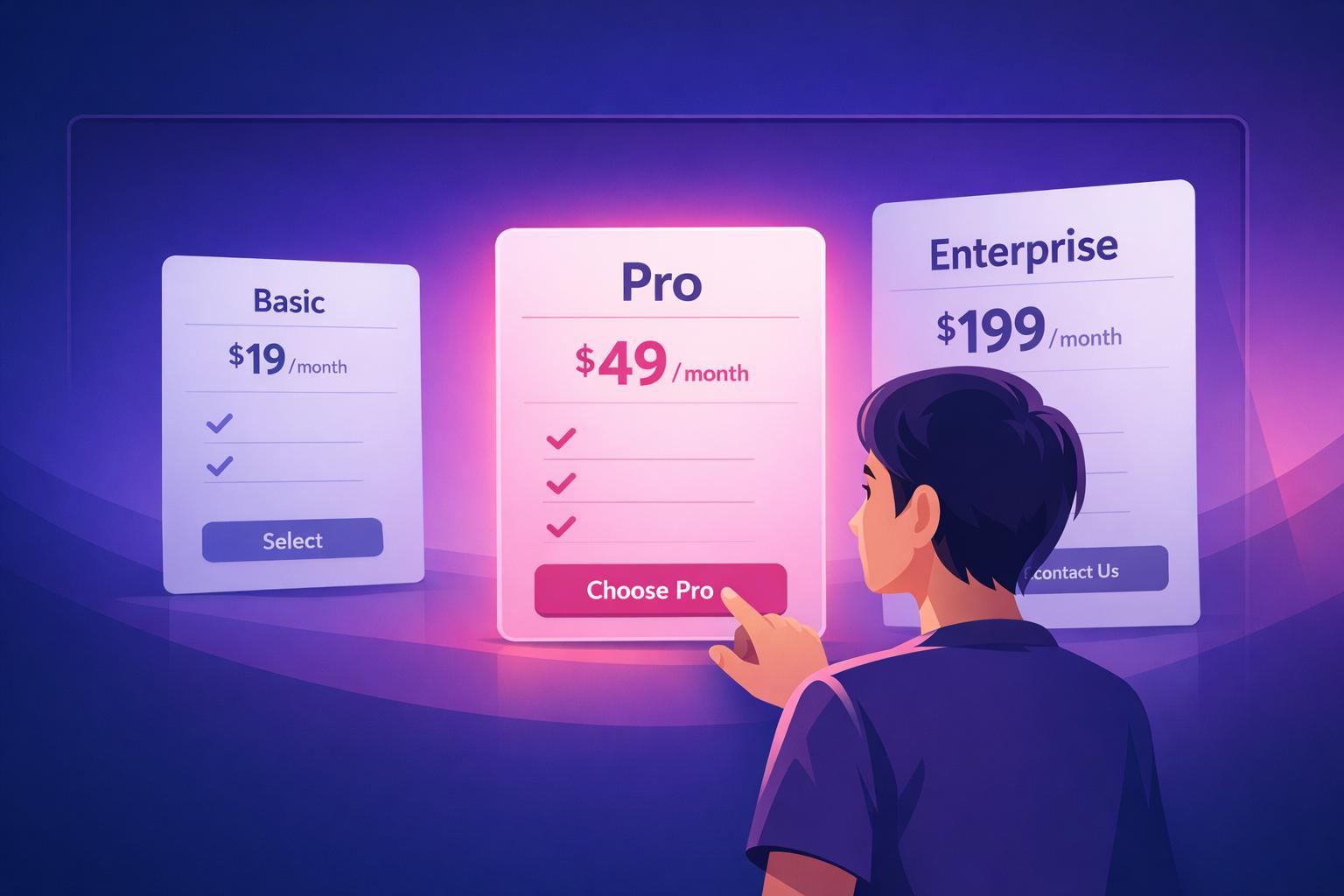
Price anchoring is a psychological pricing strategy that influences how customers perceive value. In SaaS, the first price a customer sees (the "anchor") sets a reference point, shaping how they evaluate all other pricing options. For example, displaying a high-priced Enterprise plan first makes lower-tier options, like a Professional plan, seem more affordable by comparison.
Key takeaways:
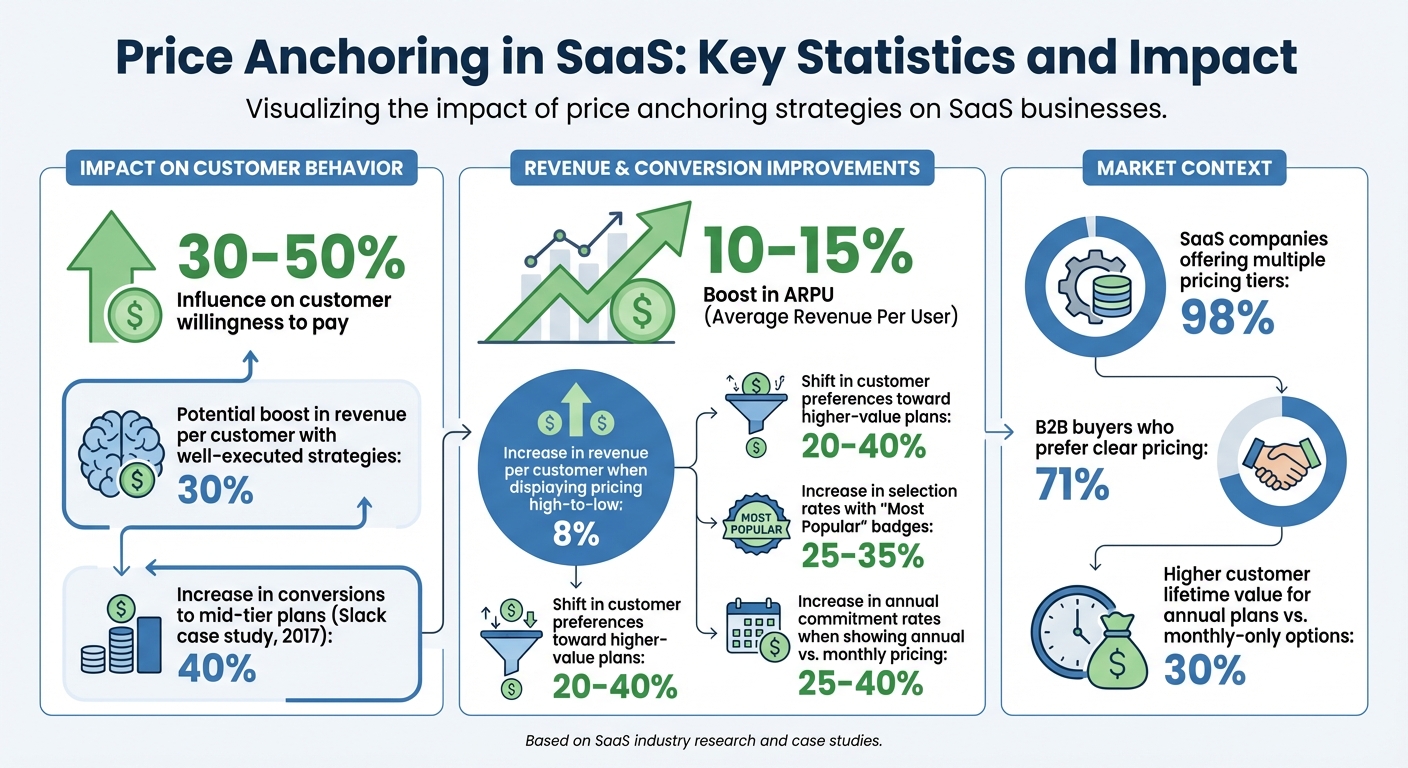
- Anchoring can sway customer willingness to pay by 30-50%.
- Well-executed strategies can boost revenue per customer by 30%.
- Tactics include tiered pricing, monthly vs. annual comparisons, and feature-based anchoring.
Slack’s introduction of its high-priced "Enterprise Grid" tier in 2017 led to a 40% increase in conversions to its mid-tier plan. Similarly, companies like HubSpot and Adobe use high-price anchors and clear contrasts to drive decisions. By understanding and testing these strategies, SaaS businesses can guide customers toward higher-value plans and improve revenue.
Price Anchoring Impact on SaaS Revenue and Conversions
What Is Price Anchoring?
Definition and Core Concept
Price anchoring refers to a psychological effect where customers rely heavily on the first price they see - known as the "anchor" - to judge the value of subsequent options. In the SaaS world, companies often use this tactic by presenting a high-priced option first, making lower-priced tiers seem more appealing in comparison. For instance, a pricing page might feature an Enterprise plan at $3,600 per month to set the stage. When a Professional plan is then shown at $890 per month, that lower price feels much more reasonable. This strategy works especially well in SaaS, where clear external pricing benchmarks are often absent.
The Psychology Behind It
Let’s dig into why this works. The concept of anchoring was introduced by psychologists Amos Tversky and Daniel Kahneman in 1974. They found that people don’t evaluate prices in isolation; instead, they compare them to an initial reference point. Once an anchor is set, customers adjust their perception of value - but these adjustments are usually incomplete, leaving them influenced by the original price.
"The first price a customer sees creates a mental reference frame that colors how they evaluate every subsequent price." - BuildMVPFast Team
In one notable study, participants' estimates shifted by as much as 20 percentage points based on the initial value they were shown. Even when people are aware of the anchoring effect, it still impacts their decisions, proving just how deeply ingrained this bias is.
Why Price Anchoring Works in SaaS
How It Shapes Customer Perception
SaaS products don’t come with a physical form, so buyers rely heavily on pricing as a way to gauge value. For instance, if an Enterprise plan is priced at $3,600 per month, that high figure becomes a mental benchmark. Suddenly, a Professional plan priced at $890 per month feels like a much better deal by comparison.
This approach works because anchors act as shortcuts in decision-making. Instead of overanalyzing every detail, customers use the anchor as a guidepost for value assessment.
"Companies often make the mistake of anchoring on features rather than value outcomes."
- Madhavan Ramanujam, Pricing Strategist
It’s worth noting that nearly all SaaS companies - 98%, to be exact - offer multiple pricing tiers. This setup encourages comparative anchoring, where customers assess value by comparing options side-by-side. While people may struggle to determine the exact worth of something intangible, they excel at spotting relative differences.
This shift in perception doesn’t just make plans look more appealing - it has a direct impact on improving conversions and revenue.
Impact on Conversions and Revenue
Presenting pricing tiers from high to low can increase revenue per customer by 8%, boost ARPU by 10% to 15%, and even shift customer preferences toward higher-value plans by 20% to 40% - all without changing a single feature.
Even small design tweaks can make a big difference. For example, marking a plan as "Most Popular" can increase selection rates by 25% to 35%. Similarly, showing annual pricing alongside monthly options can push annual commitment rates up by 25% to 40%. The first price a customer sees also plays a critical role, as it can shape their willingness to pay by as much as 30% to 50%.
These results highlight the incredible potential of price anchoring as a strategy for SaaS companies to drive conversions and maximize revenue.
Price Anchoring Techniques for SaaS
Tiered Pricing Structures
The three-tier pricing model - commonly labeled as Basic, Professional, and Enterprise - has become a go-to strategy for SaaS businesses. This approach leverages the Goldilocks effect, where customers tend to favor the middle option as a balanced choice between cost and features.
To maximize this effect, present your pricing options starting with the most expensive tier (either left-to-right or top-to-bottom). This method sets a high anchor, making other tiers appear more affordable. Research shows that switching from a low-to-high to a high-to-low pricing display can increase revenue per customer by around 8%. For instance, HubSpot lists its Enterprise plan at US$3,600 per month, creating a steep anchor that makes its US$890 Professional plan seem like a bargain.
Visual elements can further guide customer decisions. Adding a "Most Popular" badge to the middle tier has been shown to increase its selection rate by 25%. Another tactic is decoy pricing - introducing a slightly cheaper but less valuable option near your target tier. This makes the target plan look like the best deal. In fact, simply including a higher-priced tier can boost mid-tier selections by about 40%.
Now, let’s explore how comparing monthly and annual pricing can further enhance anchoring strategies.
Monthly vs. Annual Pricing Comparisons
Displaying both monthly and annual pricing options creates a dual anchor effect. The higher monthly rate serves as a reference point, while the discounted annual price appeals to customers' desire to avoid losses. This approach taps into loss aversion psychology, encouraging longer-term commitments.
One effective tactic is to show the annual price broken down into a monthly equivalent (e.g., "US$10/mo billed annually") alongside the standard monthly rate. This minimizes the perceived impact of a large upfront payment while emphasizing savings. For example, Adobe Creative Cloud offers a monthly plan at US$79.99 compared to an annual plan (billed monthly) at US$52.99, highlighting a 33% savings.
"Value and willingness to pay are relative and contextual… It is a measure of desire." - Dan Balcauski, Pricing Strategist
Clear labels like "Save 20%" or "2 Months Free" can further reinforce the benefits of annual billing. SaaS companies that effectively promote annual plans often see a 30% higher customer lifetime value compared to those that only offer monthly options. To create a strong contrast, aim for discounts in the 40% to 50% range compared to the shortest-term plan.
Usage-Based and Feature Tier Anchoring
Premium features can act as powerful anchors for perceived value. For example, if you highlight that an advanced analytics feature is "worth US$10,000 alone" but is included in a plan, customers may be 15% to 20% more willing to pay for it.
Another effective strategy is to emphasize high usage limits in premium tiers. For instance, offering "unlimited users" in your top-tier plan underscores the constraints of lower-tier options. Always lead with the premium tier in your pricing display, as this sets a strong benchmark for value.
Additionally, using round numbers for premium tiers (e.g., US$1,000) and more specific figures for target tiers (e.g., US$497) can subtly reinforce the perception of value.
How to Implement Price Anchoring
Step 1: Analyze Customer Data
Before diving into price adjustments, you need to define your pricing goal. Are you targeting more new customers, boosting your Average Contract Value (ACV), or steering users toward a specific plan? Your objective lays the groundwork for every decision that follows.
To pinpoint critical price thresholds and identify where users drop off, make use of tools like heatmaps, session recordings, and customer interviews. If you're working with developer-focused products, dig into technical usage metrics. Additionally, conduct value research to determine the highest price a customer might find "uncomfortable" but not outright reject. This should be based on the tangible business outcomes your product delivers.
"The most sustainable pricing strategies align pricing with genuine customer value perception." - Marco Bertini, Professor, Harvard Business School
A practical approach is to calculate the cost of inaction. For example, if your B2B SaaS tool automates tasks that cost businesses $3,200/month to handle manually, and your solution is priced at $79/month, this becomes a compelling anchor.
Step 2: Design Anchor-Based Pricing Models
Using the insights from your customer data, craft pricing tiers with intention. A proven strategy is the Rule of Three: create a Premium Anchor tier, a Target Option tier, and a Basic Entry tier. Set your Target tier price 50–70% lower than the Premium Anchor.
Always present your tiers from highest to lowest price. A great example is Slack’s introduction of its Enterprise Grid tier in early 2017. By anchoring with this high-priced option, Slack saw a 40% boost in conversions to its mid-level Plus tier ($12.50/user/month) within one quarter.
For anchors, use round numbers (e.g., $1,000) to make them feel substantial, but opt for precise pricing for your Target tier (e.g., $497) to make it seem more calculated and justified. You can also introduce a decoy tier - a similarly priced option with fewer features - to drive more customers toward your mid-tier plan. This tactic can increase mid-tier selection rates by 40–60%.
Don’t underestimate the impact of design. Place your key anchor or target tier in the upper-left corner of your pricing table, as this is where users naturally focus first.
Once your pricing models are ready, the next step is to validate them through testing.
Step 3: Test and Optimize Your Anchors
Testing is crucial, and it’s best to approach it step by step. Start with the packaging and clarity of your plans, then move on to testing value anchoring, discount strategies, and finally, specific price points. This methodical approach ensures you’re not misinterpreting results caused by overlapping variables.
Zendesk provides a great example. By prominently displaying their high-end Enterprise solution as the first option on their pricing page, they increased the selection rate of their Professional tier by 18%. Similarly, when Dropbox streamlined its business pricing from five tiers to three in 2020, the reduced number of competing anchors led to better conversion rates and higher average revenue per user.
During tests, it’s crucial to maintain consistent pricing across accounts. For instance, all stakeholders from the same organization should see the same price. Use domain-based or cookie-based systems to ensure this consistency and avoid eroding trust.
Track a range of metrics, not just initial conversion rates. Pay attention to retention rates by plan, price sensitivity during renewals, and long-term lifetime value. This will help you gauge whether your anchoring strategy is delivering sustainable results. At the same time, monitor trust metrics to ensure your pricing approach enhances - not undermines - the perceived value of your product.
5 SaaS Pricing Strategies That Will Boost Your Revenue in 2026
Examples of Price Anchoring in SaaS
Let’s look at how price anchoring works through some real-world examples from SaaS companies and beyond.
Slack is a standout example of this tactic. By introducing its high-priced "Enterprise Grid" tier, Slack made its Plus plan ($12.50/user/month) seem much more affordable. This strategy worked wonders, leading to a 40% boost in conversions to the Plus tier.
HubSpot takes a different approach with its well-defined tier structure. The company anchors its pricing with an Enterprise solution at $3,600/month, making the Professional plan ($890/month) and Starter plan ($45/month) feel like better deals. This wide price gap caters to different audiences: small businesses see the Starter plan as accessible, while growing companies perceive the Professional tier as a reasonable middle ground compared to the Enterprise option.
Adobe Creative Cloud uses another clever variation of price anchoring. It contrasts monthly and annual billing options, displaying the monthly price (billed annually) next to a much higher month-to-month rate. This side-by-side comparison highlights the savings of committing to an annual plan, making it feel like a better deal - even though customers pay upfront.
Interestingly, price anchoring isn't limited to SaaS. July, a premium luggage brand, applied this principle using Shopify Scripts to bundle products. By comparing the bundle price to the higher cost of buying items individually, July created a sense of great value. This strategy paid off big, contributing to a 640% increase in year-over-year sales as the brand expanded into the U.S. market in 2025.
What ties these examples together? Whether it’s Slack’s premium tier, HubSpot’s tiered pricing, Adobe’s billing contrast, or July’s product bundling, each strategy uses a clear reference point to nudge customers toward a specific choice. It’s all about shaping perception to guide decisions.
Conclusion
This article has delved into how smart pricing anchors can transform customer perceptions and fuel SaaS growth. Price anchoring isn’t just a tactic - it’s a psychological approach that influences how customers perceive the value of your product. When applied carefully, it can increase conversions to mid-tier plans by as much as 40%.
A strong pricing strategy blends multiple techniques. For instance, starting with your premium tier sets a high reference point, while the Rule of Three simplifies the decision-making process. However, it’s critical that your anchor reflects a real plan that delivers actual value, rather than an inflated figure. Pricing strategist Dan Balcauski emphasizes this point:
"Value and willingness to pay are relative and contextual… It is a measure of desire"
Transparency also plays a key role. While 71% of B2B buyers prefer clear pricing, there’s still room to strategically frame your options. Just ensure your premium anchor is a legitimate offering, not an exaggerated price designed solely to make other plans seem more appealing. Thoughtful framing bridges the gap between perceived value and measurable outcomes.
Companies that regularly test and refine their pricing strategies often see measurable gains. Case studies show that A/B testing anchors and layouts can lead to incremental revenue improvements.
FAQs
How do I pick the right anchor price for my top plan?
To determine the ideal anchor price for your top-tier plan, focus on setting a high yet believable price that represents the full value your solution delivers. It’s crucial that this price aligns with what your customers are willing to pay. To get it right, conduct detailed research into the value your offering provides - don’t just pick a number at random. A well-chosen high anchor price acts as a reference point, making your lower-priced plans look more appealing and helping steer customer decisions in the right direction.
When does price anchoring hurt trust or conversions?
Price anchoring can backfire if it comes across as manipulative or if the original price feels exaggerated or unrealistic. When this happens, customers might doubt the fairness of your pricing, which can erode trust and lower their confidence in what you're offering.
What should I A/B test first on my pricing page?
When presenting prices, start by experimenting with price anchoring strategies. For instance, display a premium plan first as a high-price anchor. This can make other options feel more affordable by comparison.
Also, pay attention to the design and layout of your pricing. Test how the placement, size, and contrast of price elements affect their visibility and appeal. Small adjustments here can tap into psychological triggers, potentially boosting conversions and fine-tuning your overall pricing approach.