Customer Success Role in SaaS Upselling
Customer Success Role in SaaS Upselling
Upselling in SaaS is a game-changer for revenue growth. Instead of focusing solely on acquiring new customers, SaaS companies are increasingly turning to Customer Success (CS) teams to drive expansion within their existing customer base. Here's why this shift matters:
- 40% of SaaS revenue now comes from expansion, with renewals and upsells accounting for up to 70% of total revenue.
- CS teams build long-term relationships, track product usage, and identify growth opportunities before anyone else.
- Companies that empower CS teams for upselling see benefits like a 24% lower churn rate and 120% net expansion per year, as reported by Proposify in 2025.
What makes CS effective at upselling? Unlike sales teams, which focus on closing deals, CS teams act as trusted advisors, ensuring customers succeed with their current products. This trust allows them to recommend upgrades - like higher-tier plans or premium features - as solutions to customer challenges, not just revenue drivers.
When Sales and Customer Success align, the results are even stronger. Companies that integrate these teams achieve 2.4x faster revenue growth by leveraging shared data, clear roles, and tools like health scores and real-time dashboards.
Key Takeaways:
- Upsell Triggers: Usage milestones (e.g., hitting capacity limits) and support themes (e.g., requests for advanced features) signal opportunities.
- Metrics to Track: Net Revenue Retention (NRR), Expansion MRR, and Customer Health Scores help measure success.
- Proven Models: CS-led upselling strategies, supported by personalized recommendations and educational content, drive higher customer satisfaction and revenue.
Upselling isn't just about revenue - it's about helping customers grow with your product. By equipping CS teams with the right tools and aligning them with sales, SaaS companies can turn retention into a powerful growth engine.
10 essential upselling best practices every Customer Success Manager needs to know
How Sales and Customer Success Differ in Upselling
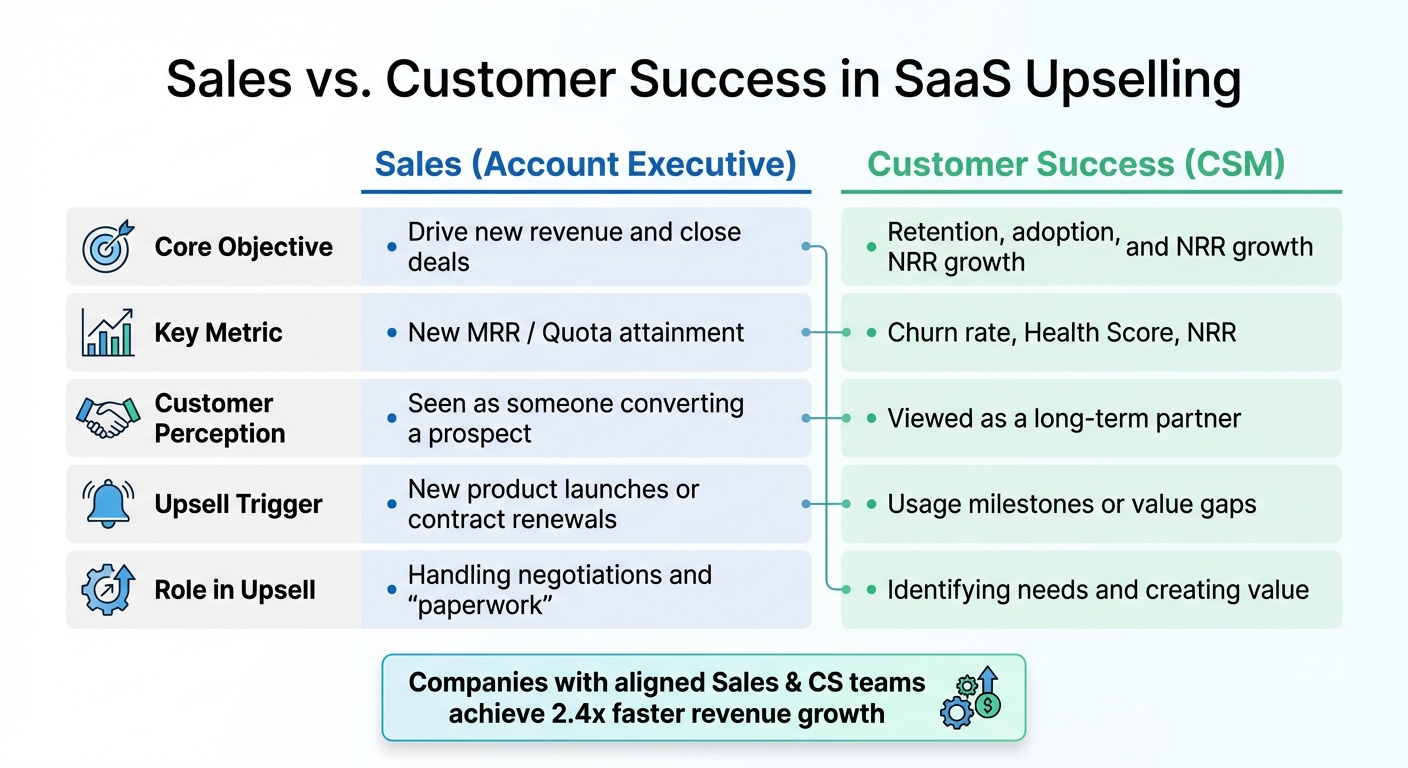
Sales vs Customer Success in SaaS Upselling: Key Differences
Sales vs. Customer Success Responsibilities
Sales and Customer Success teams bring very different approaches to upselling. Account Executives (AEs) are laser-focused on closing deals and meeting revenue goals, primarily by acquiring new customers and driving fresh revenue streams. They're skilled negotiators who know how to position solutions strategically and push deals through the pipeline efficiently.
Customer Success Managers (CSMs), on the other hand, prioritize retention, driving product adoption, and helping customers achieve their goals. Their focus isn’t on closing deals but on ensuring customers succeed with what they’ve already purchased. This creates a unique dynamic: Sales often takes on the role of the "closer", while Customer Success acts as a "trusted advisor", fostering loyalty with deep product knowledge and ongoing support.
From the customer’s perspective, these roles can feel very different. When a salesperson suggests an upgrade, it might be seen as a push for more revenue, sometimes leading to a defensive reaction. But when a CSM makes a similar recommendation, it’s often viewed as genuine advice from someone who understands their business and wants to help.
SaaS companies handle upselling responsibilities in various ways. Some follow a Sales-Led model, where AEs oversee all commercial activities, leaving CS to focus solely on delivering value. Others use a Split model, with Sales managing new revenue and CS taking care of renewals. Increasingly, companies are adopting a CS-Led model, where Customer Success owns all revenue from existing customers - renewals and expansions - while Sales focuses solely on acquiring new clients.
These distinctions naturally set the stage for collaboration between Sales and CS, which can lead to more effective upselling strategies.
How Sales and CS Work Together on Upsells
Despite their differing roles, aligning Sales and Customer Success can drive impressive results. In fact, top SaaS companies that achieve this alignment experience growth rates 2.4 times faster than others.
One popular strategy is the "quarterback" model. Here, CSMs identify customer needs and potential expansion opportunities, then delegate tasks like procurement and legal processes to Sales. This division of labor allows each team to focus on their strengths. As Nick Paranomos, Co-founder and COO of 'nuffsaid, puts it:
"Success owning expansions doesn't mean that it should be the 'everything' function. CSMs should still delegate upsell and cross-sell 'paperwork' (procurement, legal, and security) to the Sales team".
Collaboration should ideally begin before the deal is even closed. Involving CSMs during the sales cycle helps establish early rapport with customers and ensures that implementation plans are realistic. This approach also reduces the risk of Sales overpromising features, which can lead to frustration and extra work for Customer Success down the line.
Using unified CRMs and conducting regular joint planning sessions can help both teams stay aligned. These tools and practices ensure that everyone has visibility into customer interactions and can focus on high-value accounts for smoother and faster upsell execution. Regular communication between the teams also ensures consistent messaging throughout the customer journey.
| Feature | Sales (Account Executive) | Customer Success (CSM) |
|---|---|---|
| Core Objective | Drive new revenue and close deals | Retention, adoption, and NRR growth |
| Key Metric | New MRR / Quota attainment | Churn rate, Health Score, NRR |
| Customer Perception | Seen as someone converting a prospect | Viewed as a long-term partner |
| Upsell Trigger | New product launches or contract renewals | Usage milestones or value gaps |
| Role in Upsell | Handling negotiations and "paperwork" | Identifying needs and creating value |
Customer Success Upselling Strategies
Using Customer Data for Personalized Recommendations
Customer Success teams can uncover upsell opportunities by analyzing how customers use their product. For example, when customers consistently use 90% of their seat, storage, or API limits over a two-week period, it’s a clear sign they might need an upgrade. Similarly, a 25% week-over-week spike in team invites often signals growing internal adoption.
Support tickets also reveal valuable intent signals. By categorizing tickets into themes, teams can prioritize outreach effectively. For instance, requests for single sign-on (SSO) suggest the customer may be ready for an enterprise-level plan, while complaints about file limits point to an immediate need for additional storage. Automated alerts for recurring issues, like multiple "rate limit exceeded" tickets in a quarter, enable teams to act quickly and proactively.
The impact of acting on these signals is clear: 75% of revenue teams say real-time account and intent data helps them uncover expansion opportunities they might have missed. Additionally, personalized offers based on customer data lead to 68% of customers feeling more positive about the brand.
| Signal (Support Theme) | Likely Need | Suggested Upsell | Priority |
|---|---|---|---|
| "Requesting SSO" | Security & compliance | Enterprise tier with SAML/SCIM | High |
| "File limit reached" | More capacity | Storage add-on bundle | High |
| "Manual CSV export" | Advanced reporting | Analytics module | Medium |
| "Need Snowflake sync" | Data integration | API or ETL connector pack | Medium |
These insights feed directly into health scoring systems, helping teams prioritize outreach and engage with customers at the right time.
Health Scores and Proactive Outreach
Health scores are a powerful tool for identifying accounts that are ready for upselling. Customers scoring between 80 and 100 typically show strong engagement and satisfaction, making them ideal candidates for expansion. Timing is everything - reaching out right after a customer hits a major usage milestone or starts a new internal initiative can significantly improve the chances of a successful upsell.
Other metrics, like a DAU/MAU ratio above 0.6 sustained over a month, indicate deep product dependency and readiness for growth. Combining this with Net Promoter Scores (NPS) further sharpens targeting. For example, focus on customers with an NPS of 9 or higher who have seen at least a 15% increase in usage since their last survey.
The results of such scoring systems are compelling. They can reduce churn by 20–30% and drive revenue growth of 12–20% through targeted upselling. However, timing matters - if a customer is dealing with unresolved support issues or implementation challenges, it’s better to hold off on upsell conversations to avoid damaging trust.
Educational Content and Feature Bundles
Educational content plays a key role in reinforcing upsell efforts. For example, after onboarding or as customers approach their usage limits, automated email sequences can highlight how premium features address specific needs. Tailored messages like “We noticed your team is using Feature X heavily; Feature Y could help you scale more efficiently” create a personalized experience that resonates.
Social proof is another effective tool. Sharing success stories from similar customers helps reduce the perceived risk of upgrading. Showing before-and-after comparisons with real data - such as “Teams on the premium tier complete projects 40% faster” - makes the value of an upgrade crystal clear.
Behavior-driven upselling, which leverages these personalized insights, achieves 28% higher close rates compared to generic prompts. Bundling educational resources with upgrades, like premium courses or certifications, makes transitions smoother and justifies premium pricing. Quarterly Business Reviews also provide an excellent opportunity to present these bundles, positioning upgrades as collaborative solutions rather than sales pitches.
Aligning Customer Success and Sales Teams
Shared Data and Account Visibility
Bringing teams together starts with unified systems. When Sales uses a CRM like Salesforce and Customer Success relies on a platform like Gainsight, critical information often gets stuck in silos. The solution? Integrating these tools to create one reliable source of truth for both teams. This way, Customer Success Managers (CSMs) can access the original deal details - what was promised, the customer’s pain points, and their goals - while Sales gains insights into engagement metrics and health scores that indicate when customers might be ready for expansion.
Aligned teams don’t just work better - they perform better. Companies with strong alignment see 2.4x faster revenue growth and double their profitability. On the flip side, misalignment can drain 10% or more of annual revenue. Tools like real-time dashboards, which consolidate behavioral data, support response times, and contract health, empower both teams to act quickly on opportunities or address risks like potential churn.
"If you have friction between Sales, CS, Marketing, and Product, you will have friction with your customer." - Chris Dishman, SVP of Global Customer Success, Totango
Shared digital spaces, such as "Account Rooms", make collaboration seamless. These centralized hubs store all customer interactions, documents, and history in one place. For CSMs, this visibility means they can immediately understand why the customer bought and what success looks like for them, rather than wasting time piecing together information that Sales already has. This streamlined access to data lays the groundwork for defining roles that enhance collaboration.
Clear Roles and Objectives
Once teams share data, the next step is defining roles. Clarity eliminates confusion and overlap. A RACI matrix (Responsible, Accountable, Consulted, Informed) is a proven tool for assigning ownership of key tasks like onboarding, renewals, and upselling. For instance, while the CSM identifies expansion opportunities based on usage trends, Sales takes charge of negotiating contracts and managing procurement. With responsibilities clearly outlined, both teams can focus on driving growth throughout the customer lifecycle.
Regular joint planning sessions keep everyone on the same page. Instead of occasional updates, bi-weekly account reviews provide a consistent rhythm for tracking customer progress and identifying growth opportunities. These meetings have a direct impact: companies report a 36% increase in customer satisfaction, 25% more upsell opportunities, and 20% higher retention rates. And customers notice - 70% expect companies to collaborate internally on their behalf, so when teams operate in silos, it’s obvious.
To ensure nothing slips through the cracks during handoffs, creating a "deal-intent record" for each account is key. This document outlines agreed outcomes, critical requirements, and the post-sale owner’s responsibilities, including response times (SLAs). It serves as a shared roadmap, guiding both teams as they make decisions about the account’s future.
Measuring Customer Success Upselling Performance
Key Metrics for CS Upselling
Metrics turn guesswork into measurable growth. One of the most critical metrics is Net Revenue Retention (NRR), which reflects the combined effects of churn, downgrades, and expansion revenue. Top-performing SaaS companies often achieve NRRs above 120%, equating to around 20% annual growth from their existing customers. For instance, Snowflake reported an impressive 135% NRR in 2025, while Bill.com and GitLab recorded 131% and 129%, respectively.
Another important metric is Expansion MRR, which tracks revenue from upgrades and add-ons. The Upsell Conversion Rate measures the percentage of identified upsell opportunities that close successfully, with B2B portfolios typically landing between 40% and 70%. Effective upselling not only increases Customer Lifetime Value (CLV) but also reduces churn. For example, CreatorIQ achieved a 25% year-over-year boost in CLV while cutting churn by 15% through well-executed upselling.
Customer Health Scores are invaluable for spotting upsell-ready customers. These scores combine data on usage, engagement, and sentiment to identify expansion opportunities. Metrics like Average Order Value (AOV) and the DAU/MAU ratio (daily active users to monthly active users) also provide insights. A DAU/MAU ratio above 0.6 for a full month indicates strong product engagement and readiness for expansion. Together, these metrics establish benchmarks and help evaluate strategy effectiveness, reinforcing the role of Customer Success in driving upsell revenue.
Typical SaaS Upselling Benchmarks
Benchmarks define what success looks like. Across the SaaS industry, healthy upsell rates typically range from 20% to 30% annually. Early-stage companies often see upsell rates between 10% and 15%, while growth-stage companies achieve 15% to 25%. Enterprise-focused leaders can exceed 30%. Additionally, best-in-class SaaS companies often realize 10% to 15% annual growth in Average Revenue Per Account (ARPA) within their existing customer base.
Upselling proves more cost-effective than acquiring new customers. It costs roughly $1.18 to generate $1 from an existing customer, compared to $1.68 for a new customer - a 42% difference. Companies that dedicate specialized teams to expansion within Customer Success see 28% higher net retention rates compared to those focusing solely on retention. In fact, leading SaaS companies generate 30% to 40% of their new Annual Recurring Revenue (ARR) from existing customers.
"As cold outbound channels get harder, things like word of mouth, referrals, and expansion matter more than ever."
- Hakan Ozturk, Founder, The CS Café
These benchmarks provide crucial context for evaluating upselling strategies and their effectiveness.
Comparing Upselling Strategy Trade-offs
Different strategies come with their own pros and cons. Capacity-based upselling, such as charging for additional seats, storage, or API usage, creates natural upgrade paths and can often be automated. However, customers might view these limits as a "tax" on growth if they feel restrictive. Feature-based upselling, offering premium modules, can address specific pain points and foster deeper product engagement, but it often demands clear ROI justification and involves longer sales cycles.
| Strategy | Advantages | Challenges |
|---|---|---|
| Capacity-based (Seats/Storage) | Natural upgrade path; high conversion; triggered by usage. | May feel like a "growth tax"; rigid limits can frustrate customers. |
| Feature-based (Premium Modules) | Solves specific pain points; adds high value; deepens product engagement. | Requires strong ROI proof; longer sales cycles; needs customer readiness. |
| Tier-based (Plan Upgrades) | Simplifies pricing; offers clear value steps; easy to understand. | May force customers to pay for unused features; higher entry barriers. |
| Bundle-based (Feature Sets) | Boosts Total Contract Value (TCV); provides complete solutions. | Complex procurement; harder to justify for smaller accounts. |
Monitor "no decision" rates carefully. If more than 20% to 25% of upsell opportunities result in no action, it often signals unclear value propositions or excessive procurement hurdles. For example, Proposify recently achieved a 120% net expansion rate by addressing such challenges. Understanding these trade-offs helps Customer Success teams choose strategies that drive sustainable revenue growth.
Conclusion
Customer Success has become a key driver of revenue, with Customer Success Managers (CSMs) acting as trusted advisors who use real customer data to identify growth opportunities beyond retention. By analyzing usage patterns and health scores, they can time upsell offers perfectly - whether it’s when a customer hits a license limit or reaches an important milestone. This strategy not only fuels growth but also enhances customer satisfaction.
The collaboration between Sales and Customer Success further strengthens this approach. When Sales and CS align, upsell opportunities increase, and customer retention improves. Shared metrics, such as Net Revenue Retention (NRR), ensure both teams prioritize long-term growth over short-term wins. Companies with strong alignment between these teams report 2.4× faster revenue growth and twice the profitability compared to their competitors.
"The hard truth that we have to face as Success leaders is that we're hurting our customers and our companies by expecting Sales to drive expansion."
- Nick Paranomos, Co-founder and COO, 'nuffsaid
To thrive, CSMs must transition from being customer advocates to becoming revenue drivers, supported by focused mentorship. Platforms like Stackd connect go-to-market (GTM) professionals with seasoned mentors for 1-on-1 guidance. These sessions help CSMs master frameworks like MEDDIC and adopt a CEO-like mindset to deliver measurable results for their accounts. In this supportive environment, they can also rehearse challenging conversations without “practicing on customers”. With these skills, teams are better prepared to navigate future growth challenges.
Expansion is the future of sustainable revenue growth. Upsells are crucial, as up to 70% of subscription revenue originates from existing customers. Well-equipped CS teams can achieve an impressive 120% net expansion annually. This holistic approach transforms retention into a powerful growth engine.
FAQs
When should a CSM bring up an upsell?
Timing is everything when it comes to introducing an upsell as a Customer Success Manager (CSM). The best moments to bring it up are when it naturally aligns with the customer’s needs and readiness. For instance, consider suggesting an upsell when:
- The customer is approaching their renewal period.
- They've hit a major milestone in their journey.
- Their current plan is limiting their ability to achieve their goals.
By focusing on these key opportunities, you can ensure the upsell feels relevant and genuinely supports the customer’s objectives.
Which product signals best predict an upsell?
Upsell opportunities often emerge through product usage patterns. For instance, when customers start adopting more features, require additional data storage or processing capabilities, or expand their collaboration within your platform, it’s a clear sign. These behaviors highlight their changing needs and suggest they might be ready to invest more in your product.
How do Sales and CS split upsell work?
Sales teams often take the lead in upselling and cross-selling efforts, using their knowledge of customer needs and timing to identify opportunities for additional purchases. On the other hand, customer success teams prioritize renewals and retention, ensuring customers remain satisfied and loyal. When these two teams collaborate effectively - sharing goals and maintaining strong communication - it can significantly boost upsell success. Clearly outlining each team's responsibilities is essential for creating a smooth customer experience and unlocking growth opportunities.