
5 Signs You're Ready for a Marketing Leadership Role
5 Signs You're Ready for a Marketing Leadership Role
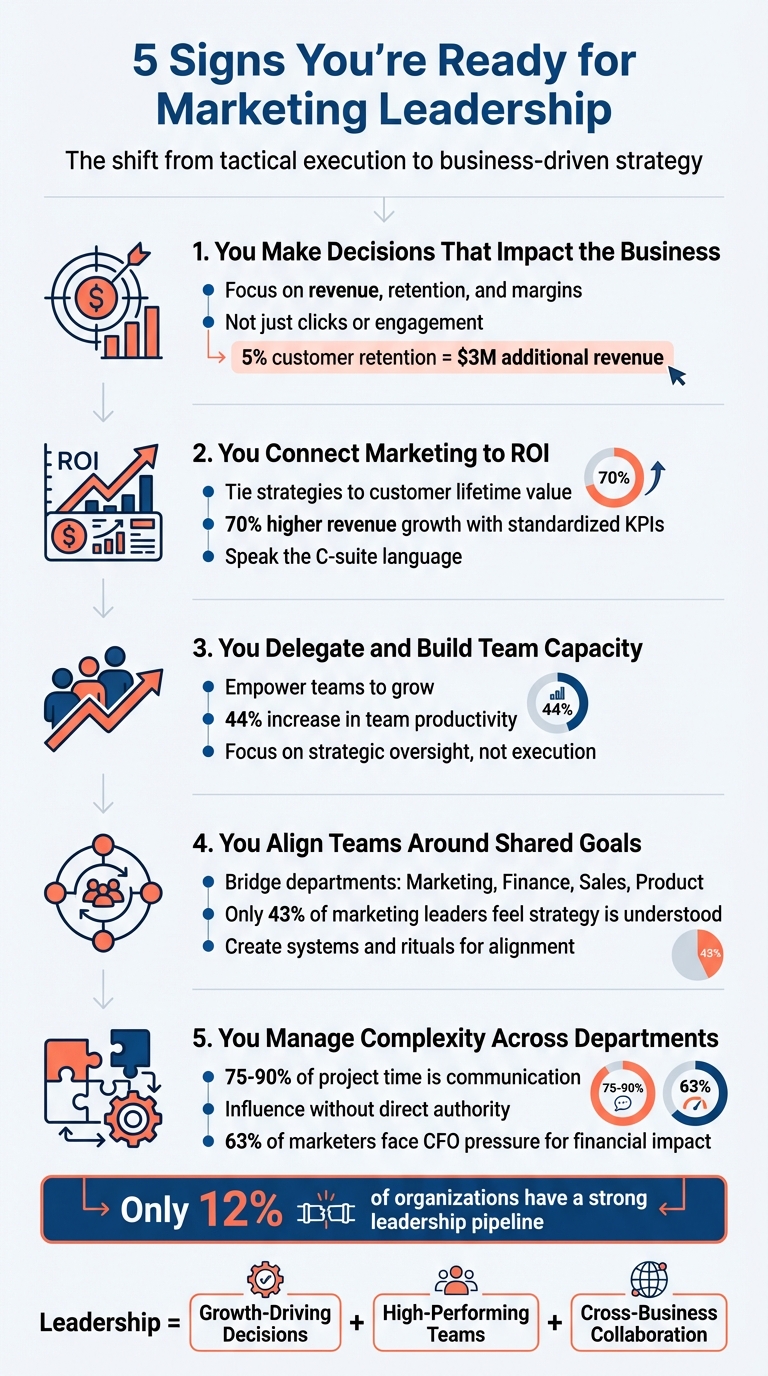
Thinking about stepping into a marketing leadership role? Here's what sets future leaders apart: the ability to shift from tactical execution to business-driven strategy. Success isn’t just about running campaigns - it’s about driving measurable outcomes, managing teams effectively, and aligning with broader business goals.
Here are the 5 key signs you’re ready:
- You make decisions that impact the business. Leaders focus on metrics like revenue, retention, and margins - not just clicks or engagement.
- You connect marketing efforts to results. You know how to tie strategies to ROI, customer lifetime value, and shareholder impact.
- You delegate and build team capacity. Leadership means empowering your team to grow while focusing on strategic oversight.
- You align teams around shared goals. Leaders ensure everyone - from Marketing to Finance - works toward the same objectives.
- You manage complexity across departments. It’s not about doing everything yourself but creating systems that keep projects on track.
Bottom line: Marketing leadership requires a mindset shift. It’s about making decisions that drive growth, building high-performing teams, and collaborating across the business. If you’re ready to lead, these skills will set you apart.
5 Signs You're Ready for Marketing Leadership Role
Dave Gerhardt on Marketing Leadership and Team Building
1. You Make Clear Decisions That Move the Business Forward
Marketing leaders don’t just manage campaigns - they make decisions that drive measurable business outcomes. The key difference? Instead of celebrating "20% engagement growth", you're reframing it as "boosting customer retention by 5%, resulting in $3 million in additional revenue". That’s the kind of language leaders speak.
Take Sarah Reece, Director of Demand Generation at Orum, as an example. In 2024, she took a bold step by cutting demand capture digital spend and deprioritizing low-intent conversions. Instead, she shifted her focus to brand-driven demand generation. The payoff? A surge in direct and organic web traffic, broader social reach, and a noticeable jump in pipeline and revenue. This shift away from vanity metrics toward meaningful business outcomes is what fuels growth.
Effective decision-makers understand the financial landscape. They connect marketing investments to P&L outcomes, EBITDA, and net margins - not just metrics like clicks or engagement. If you’re not prepared to explain how your strategy impacts shareholder value during a board meeting, you’re not ready to lead.
The best leaders also operate in the "V-Zone" - the sweet spot where business priorities and customer needs align. They rely on data to show how marketing spend directly impacts revenue. For instance, Kacie Jenkins, Senior Vice President of Marketing at Sendoso, used AI, intent data, and automation to scale personalized gifting campaigns. The result? Over $1 million in outbound qualified pipeline generated each quarter.
Here’s a reality check: only 43% of marketing leaders think there’s a shared understanding of marketing strategy within their company, compared to 61% of finance leaders. If you’re ready to lead, you’re already collaborating with Finance to co-create frameworks, aligning on clear definitions of revenue and payback before requesting budget approvals. This isn’t about advancing just your team - it’s about making decisions that propel the entire business forward. And that’s just one piece of the leadership puzzle.
2. You Know How to Deliver Marketing Results That Matter
One big challenge for marketing leaders is bridging the gap between their efforts and the C-suite's focus on revenue. If you're ready to step into a leadership role, you're no longer just talking about clicks and impressions. Instead, you're connecting your marketing strategies to revenue impact, customer lifetime value, and contribution margin - metrics that truly matter for business growth.
This approach is often referred to as the "ROI Triad": Investment, Impact, and Outcome.
Marketing leaders who use standardized KPI frameworks and advanced measurement techniques achieve up to 70% higher revenue growth. They do this by balancing early indicators - like content downloads and webinar participation - with lagging metrics such as marketing-sourced pipeline and revenue impact, which confirm business results. Achieving this level of precision requires close collaboration with finance to ensure strategic alignment.
However, only 44% of senior marketers feel satisfied with their career progression, often because they struggle to demonstrate their influence within the organization. Successful leaders tackle this issue head-on by partnering with finance teams to co-develop frameworks, agree on revenue definitions, and model different investment scenarios. Steve Moffat, CMO at GoHealth, emphasizes the importance of this alignment:
"Learn to speak [the C-level executive's] language and translate marketing initiatives into the business needs that matter most to them".
What sets a marketing leader apart from a manager is their ability to not only report numbers but also explain their significance and offer strategic solutions. For example, when lead generation slows, they analyze whether the issue stems from market dynamics or creative fatigue and then propose actionable next steps.
3. You're Comfortable Delegating and Growing Your Team's Capacity
Getting caught in the "New Manager Death Spiral" can derail leadership potential. This happens when managers take on execution tasks themselves, depriving their team of valuable learning opportunities and trapping themselves in day-to-day tactical work. For a marketing leader, making the leap from micromanaging to strategic oversight is a game-changer. The best marketing leaders understand that their success is measured not by their personal output but by how capable and independent their teams become. They evolve from having a narrow, channel-specific skill set (often called the "I-shape") to cultivating a broader, strategic perspective (the "T-shape"). Instead of handling every detail, they guide the process and trust specialists to dive deep into execution. They also tailor their management approach to fit the needs of individual team members and establish structured routines that allow their teams to thrive without constant oversight.
The numbers back this up. Strong managers can increase team productivity by as much as 44% while also reducing turnover. Yet, only 12% of organizations report having a solid pipeline of talent ready to step into leadership roles - a sharp decline of 33% since 2011.
This highlights why delegation is so critical. Effective delegation doesn’t mean handing over tasks with overly detailed instructions. It starts with setting clear objectives and defining the desired outcomes. From there, it’s about giving your team the freedom to figure out the best way to achieve those goals. Stretch assignments - roles that challenge employees to grow - are particularly powerful when tied to measurable outcomes. As Mark Fiske, Operating Partner at H.I.G. Capital, wisely points out:
"When it comes to feedback some people are a Ferrari and others are a Honda Civic."
Understanding these differences and adapting your approach accordingly can make all the difference in building a high-performing team.
4. You Set Direction and Get Teams Working Toward the Same Goals
Here’s a striking stat: only 43% of marketing leaders feel there’s a shared understanding of marketing strategy within their organization, compared to 61% of finance leaders. This gap highlights the challenge - and opportunity - of turning a vision into clear, actionable goals that unite teams.
Stepping into a leadership role means moving beyond individual tasks to crafting a vision that aligns everyone’s efforts with overarching business objectives. It’s not just about strategy on paper; it’s about ensuring every team’s actions contribute to the bigger picture. Leaders must connect the dots, showing how one team’s work influences another and how all activities tie back to business goals.
Great leaders also break out of their departmental silos and communicate effectively across functions. Each team speaks a different “language”: Finance focuses on metrics like EBITDA and payback periods, Sales zeroes in on pipeline and quotas, and Product prioritizes systems and long-term growth. As Brittany Bingham, VP of Marketing at Guru, advises:
"Don't lead with an ask - no matter how good you think it is. Build a path to it. Share accountability for and understanding of goals, know what they're trying to achieve and how you can support, and provide context early".
The how matters just as much as the what. Strong leaders establish rituals and processes - like weekly check-ins, strategy retreats, and standardized reporting - that keep teams aligned and moving at a steady pace. They push their teams to move beyond surface-level metrics like impressions and clicks, focusing instead on outcomes that drive business impact, such as pipeline growth, revenue, and customer lifetime value. Collaboration with Finance is key too - together, they define performance frameworks that link marketing spend directly to profit.
When teams are aligned, the benefits are clear: higher productivity and lower turnover. Setting direction isn’t just about having a vision - it’s about creating the systems, fostering collaboration, and building shared accountability that bring that vision to life.
5. You Handle Multiple Moving Parts and Coordinate Across Departments
Being a marketing leader is like managing an intricate puzzle - balancing numerous projects while keeping everyone on the same page. And here's the reality: communication plays a massive role in whether things succeed or fall apart. Research shows that 75% to 90% of a project manager's time is spent on communication, and poor communication is cited as the top reason for project failures by up to one-third of project managers. When you're overseeing campaigns, product launches, and cross-functional projects all at once, your ability to manage complexity becomes a game-changer.
Transitioning from managing tasks to leading teams is a significant shift. It’s no longer about what you can execute but about how you can empower others. This involves setting up centralized dashboards to keep track of priorities, documenting workflows to delegate effectively, and ensuring high schedule compliance - aiming for 90% to 95% - to keep everything running smoothly. These systems aren't just about organization; they’re the foundation for leading teams beyond your direct authority.
Working across departments brings a unique challenge: influencing without direct authority. Each department has its own focus - Sales is all about hitting quotas, Finance zeroes in on EBITDA and payback periods, and Product prioritizes systems and long-term growth. Finding common ground can be tough. As Rick Silvestrini, Head of Marketing at Reforge, puts it:
"The relationship between Product and Marketing often suffers a 'death by a thousand cuts'. When Marketing teams ask for incremental, one-off, tactical fixes it makes it really difficult for Product Management to understand the whole picture".
To bridge these gaps, successful leaders tie every initiative to broader business goals, not just marketing metrics. They use ROI frameworks to show how their efforts benefit multiple departments and hold quarterly reviews with key stakeholders to ensure alignment.
But alignment alone isn’t enough. Leaders also need to translate big, complex initiatives into results that make sense to everyone. Today, 63% of marketers report feeling more pressure from CFOs to demonstrate financial impact. The best leaders meet this challenge head-on by framing their work in terms of revenue, profit, and shareholder value. They focus on breaking down bureaucratic barriers and building systems that scale, proving that managing multiple moving parts is less about working harder and more about working smarter.
Conclusion
These five indicators highlight the shift from simply executing campaigns to leading teams that deliver results critical to business success. When you focus on making clear decisions, achieving measurable outcomes, delegating responsibilities efficiently, aligning teams, and fostering collaboration across departments, you're exemplifying what Thomas Barta refers to as giving your ideas "the space to come to life". These skills demonstrate the evolution needed to meet the demands of future leadership roles.
Here’s something to think about: only 12% of organizations say they have a strong pipeline of leaders ready to step into key roles. This gap between leadership demand and readiness creates an opening for marketers who can address the trust gap with finance (by showing ROI), the power gap with other teams (through effective collaboration), and the skills gap by staying up-to-date with technical and AI advancements.
Being ready for leadership means moving beyond managing tasks to driving strategies that promote growth and cultivating an environment focused on development. Adopting this broader perspective equips you to take confident steps toward leadership.
Take a moment to evaluate your strengths and areas for improvement. If you’re ready to accelerate your journey, Stackd offers access to top SaaS go-to-market leaders who provide personalized 1-on-1 mentorship. They can help you sharpen your strategic thinking, build cross-functional influence, and enhance financial acumen. You’ll also develop essential soft skills - like empathy, conflict resolution, and strategic communication - that can often be more challenging to master than technical know-how.
Leadership isn’t about waiting for the perfect moment. It’s about recognizing the opportunities, addressing the gaps, and taking deliberate steps forward.
FAQs
What key skills do you need to move from a marketing manager to a leadership role?
Stepping into a marketing leadership role means shifting your focus from day-to-day tasks to the bigger picture - shaping strategy, nurturing your team, and driving meaningful business outcomes. It’s about turning market insights into strategies that not only align with your company’s goals but also adapt to the ever-changing landscape of trends and consumer behavior.
Clear and compelling communication is a must. You’ll need to inspire your team, bring cross-functional partners on board, and confidently present your ideas to executives. But it’s not just about what you say - it’s also about how you lead. Empowering your team, coaching individuals, and building a culture where collaboration thrives are just as important as the strategies you develop.
On top of that, having a firm handle on business essentials like managing budgets, tracking ROI, and navigating change is non-negotiable. These skills ensure that your marketing efforts deliver measurable results that truly make an impact. Master these areas, and you’ll be ready to tackle the challenges that come with leading in the marketing world.
How can marketing leaders align their teams with overall business goals?
To ensure their teams align with overarching business goals, marketing leaders should start by turning the company’s strategic priorities into specific, measurable marketing objectives. These objectives should tie directly to critical business metrics like revenue growth, customer acquisition cost, or customer lifetime value. For example, setting a clear target such as generating $5 million in additional revenue or boosting conversions by 10% helps teams focus on meaningful, results-driven efforts instead of getting sidetracked by less impactful tasks.
Leaders should also prioritize data-driven decision-making by equipping their teams with real-time performance insights through tools and regular check-ins. Monthly scorecards or sprint reviews are excellent for maintaining accountability, spotting issues early, and making quick adjustments. Collaboration across departments - like sales, product, and finance - ensures that messaging stays consistent and supports a unified approach to achieving business objectives.
Lastly, giving teams the right tools, coaching, and freedom to make decisions creates an environment where ownership and creativity thrive. By clearing unnecessary obstacles and celebrating contributions that advance company goals, leaders can inspire their teams to remain focused, motivated, and aligned with shared priorities.
Why is it important for marketing leaders to work closely with finance?
Collaboration with the finance team is essential for marketing leaders to ensure their strategies align with the company’s financial objectives. When marketing and finance work hand in hand, they can develop realistic budgets, link campaign spending to measurable ROI, and assess performance using consistent financial benchmarks. This partnership helps prevent unnecessary spending on initiatives that fail to contribute to profitable growth.
Beyond budgeting, teaming up with finance adds structure to critical areas like forecasting, resource allocation, and performance monitoring. It allows marketing leaders to set achievable revenue goals, present well-justified investment proposals to executives, and adjust strategies based on financial insights. This alignment not only supports the company’s financial health but also enhances the marketing leader’s reputation as a key contributor to the business’s overall success.