
Remote Vs. Hybrid Teams: Burnout Risks Compared
Remote Vs. Hybrid Teams: Burnout Risks Compared
Burnout is a growing concern for SaaS teams, especially in remote and hybrid work setups. Here's a quick breakdown of the key challenges and solutions for each model:
-
Remote Teams: Struggle with isolation, blurred work-life boundaries, and digital overload.
- Stats: 25% feel lonely; 81% check emails after hours; 69% report stress from digital tools.
- Solutions: Encourage asynchronous workflows, provide mental health support, and reduce "always-on" culture.
-
Hybrid Teams: Face context-switching stress, visibility concerns, and inequities between office and remote workers.
- Stats: 52.6% report unachievable demands; 72% feel exhausted; 41% of executives worry about inequities.
- Solutions: Establish clear schedules, use "one dials in, all dial in" for meetings, and create team charters.
Both setups come with unique stressors, but tailored strategies like mentorship programs and structured communication practices can reduce burnout risks. Burnout isn’t inevitable - addressing these issues head-on can help teams thrive.
The Truth About Hybrid and Remote Worker Wellbeing
Burnout Risks in Remote SaaS Teams
Remote professionals often show strong engagement with their tasks but report alarmingly low levels of wellbeing. This contrast highlights a troubling issue: while remote SaaS workers stay connected to their responsibilities, they frequently experience isolation inherent to remote work. By 2025, a staggering 86% of full-time remote employees reported feeling burned out, driven by a mix of factors.
Isolation and Loneliness
Loneliness in remote work isn't just about being alone - it's about lacking a sense of connection. As Pauso puts it:
Loneliness is the absence of felt connection, not the absence of social contact.
Virtual interactions provide surface-level communication but lack the deeper, synchronized connection needed for meaningful relationships.
A quarter of remote workers say they feel lonely "always" or "very often", and those who feel disconnected from their company's mission are 3.5 times more likely to be disengaged. Burnout often leads employees to withdraw from optional interactions, worsening their sense of isolation. Lonely workers are twice as likely to call out sick and five times more likely to miss work due to stress.
The absence of casual workplace interactions, like spontaneous hallway chats or on-the-spot problem-solving, removes natural outlets for stress relief and peer validation. Digital communications also fall short in replicating the physiological and neural responses that build trust, while physical separation fosters siloed collaboration that weakens the sense of belonging.
This growing isolation makes it even harder to maintain a healthy balance between work and personal life.
Work-Life Boundary Erosion
Without a clear physical divide between work and home, the lines between professional and personal time blur, pushing employees to exceed their contractual hours. This lack of separation often creates a culture where workers feel they must always be available, leading to chronic overwork.
Nearly half (45%) of fully remote workers reported experiencing stress the day before, and 53% of U.S. employees say they feel burned out. Among them, 35% specifically cite the difficulty of balancing personal and professional responsibilities as a key factor. Ryan Pendell, Senior Workplace Science Editor at Gallup, explains:
Managing time independently and coordinating work with others can become difficult without clear boundaries.
The more days employees spend working from home, the more likely they are to experience mental strain and work-life conflicts.
Constant digital notifications and back-to-back virtual meetings fragment attention and leave little room for mental recovery - essential for avoiding emotional exhaustion. Additionally, when work demands spill into personal time, job satisfaction drops, and intentions to quit rise. Alarmingly, working over 55 hours a week increases the risk of stroke by 35%.
These blurred boundaries often go hand-in-hand with the pressures of technology overload.
Technology Overload
Video meetings require more mental effort than face-to-face interactions. Andrea Rajic from Gable explains:
Video conferencing is more demanding than phone calls or text chats, it requires a lot of eye contact, and what's more, you're constantly looking at yourself and wondering how others perceive you.
This constant self-awareness, combined with juggling multiple screens, fuels "Zoom fatigue" and further erodes work-life boundaries. For instance, 81% of remote workers admit to checking work emails outside regular hours, 63% check work messages on weekends, and 34% even do so while on vacation.
Adding to the stress, 17% of remote employees feel pressured to appear online constantly to prove their productivity. This practice has been linked to a 13% increase in burnout symptoms. As a result, a "performativity" culture emerges, where employees focus on appearing busy rather than delivering meaningful work. Over time, burnout from technology overload can lead workers to disengage from team interactions or avoid turning on their cameras - intensifying a "loneliness spiral" that further weakens team dynamics.
These challenges highlight the need for tailored strategies to address burnout in remote work environments, which differ significantly from those in hybrid setups.
Burnout Risks in Hybrid SaaS Teams
Hybrid workers report an average of 1.1 burnout symptoms, compared to 1.0 for in-person employees and 0.7 for remote workers. This elevated rate comes from challenges unique to hybrid setups, such as frequent environment changes, concerns about visibility, and navigating both synchronous and asynchronous communication.
Context-Switching Stress
The unpredictable nature of hybrid work makes it difficult for employees to establish consistent routines. Elora Voyles, an Industrial Organizational Psychologist at Tinypulse, explains:
Hybrid requires frequent changes to those daily habits: workers have to constantly switch things up, so it's hard to find a routine when your schedule is always in-and-out the office.
This constant adjustment takes a toll on mental energy. Employees juggle dual workspaces, commutes, and logistical hurdles like hot-desking. Chartered Psychologist Gail Kinman points out that hybrid work demands extra energy, organization, and planning. The impact is clear: in a global study, 72% of hybrid workers reported feeling exhausted - almost double the rate of fully remote workers. Additionally, 52.6% of hybrid employees said their job demands felt unachievable, compared to 45.3% of remote workers and 34.9% of in-office staff. The continuous switching between environments creates a unique strain for hybrid teams.
Perceptions of Inequity
Hybrid work also amplifies feelings of inequity, which can worsen burnout. A phenomenon dubbed "hybridity positioning" puts office-based employees at an advantage, granting them better access to resources, infrastructure, and informal knowledge-sharing. For instance, those physically present during casual office conversations often stay better informed, while remote colleagues may struggle to gain visibility for their contributions. This imbalance can lead to feelings of exclusion and frustration. On-site employees may even view hybrid colleagues as less committed, fostering a "commitment stigma" that pressures remote workers to remain constantly available.
Mortensen and Haas emphasize this issue:
Hybridity's real threat is to fairness.
These inequities can harm morale and leave employees feeling professionally isolated. For individuals from underrepresented groups - who may prefer remote work to avoid biases in the office - these challenges can further reduce their visibility in leadership roles. Combined with the added strain of managing digital tools, these systemic issues create a unique burden for hybrid workers.
Technology Fatigue
Balancing in-person and virtual communication creates another layer of stress for hybrid teams. To make up for the lack of spontaneous, face-to-face interactions, hybrid employees often face "meeting creep", where the number of scheduled video calls increases, adding to their cognitive load. Dominik Katz, Ways of Working Lead at Miro, explains the pressure:
Because they have in-person and remote arrangements, hybrid employees may experience heightened pressure to go into the office when it's not required, and to attend virtual meetings that are optional.
Unclear expectations about availability only worsen the situation. A study of 320 professionals across tech, education, and finance found that while hybrid work improved flexibility, many reported moderate to high levels of digital burnout. Constantly switching between platforms and trying to demonstrate productivity in both physical and virtual settings creates what experts call a "digital paradox." The very technology that enables hybrid work often leads to mental fatigue and makes it harder to unplug.
Danielle Jacobs, Psychologist and Co-founder of The Wellbeing Lab, captures the complexity:
Hybrid workers were significantly more likely to report that they were living well, despite struggles... [but] they reported higher levels of unachievable job demands (52.6 percent) compared to workers located at home (45.3 percent).
Remote vs. Hybrid: Burnout Risk Comparison
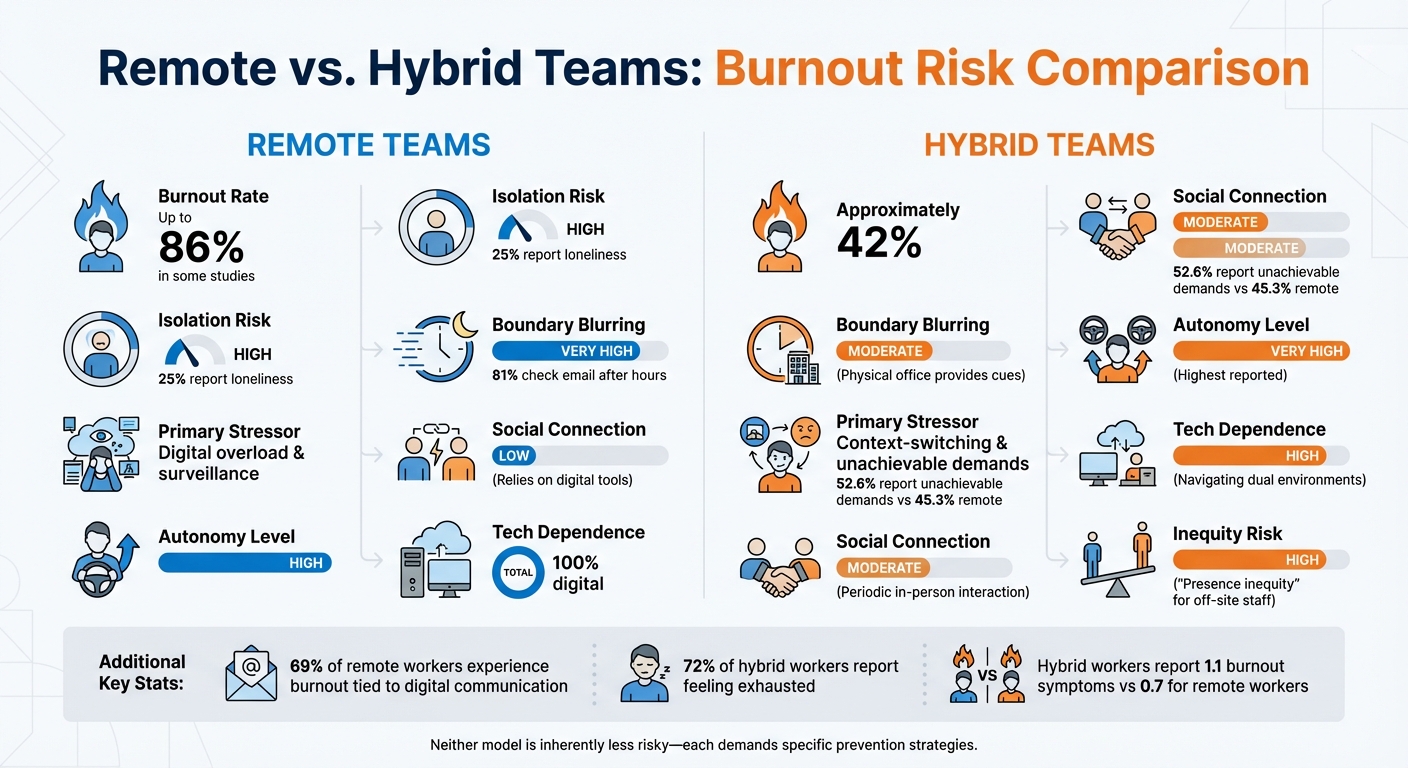
Remote vs Hybrid Teams Burnout Risk Comparison Infographic
When comparing remote and hybrid work environments, their distinct stressors reveal unique burnout risks. Remote workers often struggle with isolation and blurred boundaries between work and personal life. For instance, 25% report feeling lonely, and 81% admit to checking emails after hours. On the other hand, hybrid employees face challenges like frequent context-switching and excessive job demands, with 52.6% of hybrid workers citing these issues compared to 45.3% of remote workers.
Research shows mixed results regarding burnout rates. Some studies indicate burnout is higher among remote workers, reaching up to 86%, while others find it slightly higher in hybrid setups at 42%. This variation highlights the influence of organizational culture and support systems. As Michelle McQuaid Ph.D., a Workplace Well-being Teacher, explains:
The challenges of hybrid work appear to be moderated by the advantages of the time these workers spend in their work premises... and the time they spend working at home.
Burnout risks also depend on operational factors like digital overload. Remote teams, fully reliant on digital tools, report 69% experiencing burnout tied to digital communication. Hybrid workers, while navigating dual work environments, benefit from in-person interactions that offer periodic relief. Despite reporting the highest levels of autonomy, hybrid employees still face significant stress.
Comparison Table: Burnout Risk Factors
| Factor | Remote Teams | Hybrid Teams |
|---|---|---|
| Burnout Rate | High (up to 86% in some studies) | Moderate to High (approx. 42%) |
| Isolation Risk | High (25% report loneliness) | Moderate (21% report loneliness) |
| Boundary Blurring | Very High (81% check email after hours) | Moderate (Physical office provides cues) |
| Primary Stressor | Digital overload & surveillance | Context-switching & unachievable demands |
| Social Connection | Low (Relies on digital tools) | Moderate (Periodic in-person interaction) |
| Autonomy Level | High | Very High (Highest reported) |
| Tech Dependence | Total (100% digital) | High (Navigating dual environments) |
| Inequity Risk | Low (All are remote) | High ("Presence inequity" for off-site staff) |
For remote teams, burnout is driven by factors like isolation and the pressure to stay constantly available. Hybrid workers, meanwhile, face the complexity of balancing two work settings while maintaining visibility in both. Neither model is inherently less risky, but each demands specific strategies to address its challenges. By understanding these differences, organizations can create effective burnout prevention plans tailored to each work style.
How to Prevent Burnout in Remote Teams
Remote teams face unique challenges when it comes to burnout. For instance, 81% of remote workers check emails after hours, and 69% report stress caused by digital tools . Addressing these issues isn’t just about individual coping strategies - it’s about rethinking work practices to support well-being. Below are actionable strategies to tackle the stressors remote teams encounter and encourage healthier work environments.
Promote Asynchronous Workflows
An asynchronous-first approach to communication can ease the constant pressure to be "always-on." By setting clear expectations for non-urgent response times (e.g., 12–24 hours), teams can protect focus time and reduce interruptions, which occur, on average, every two minutes.
GitLab offers a great example of this. Co-founder Sid Sijbrandij explained:
Through iteration, you don't have to coordinate with a ton of people. By taking smaller steps through iteration, we can ship faster. The only way this is possible is through asynchronous communication.
To make this work, teams can ensure that pre-read materials are shared at least 24 hours before meetings and use project management tools to track progress. It’s also essential to define what qualifies as an emergency to prevent every issue from being treated as urgent. As Jason Fried and David Heinemeier Hansson pointed out:
The expectation of an immediate response is the ember that ignites so many fires at work.
These practices not only reduce digital interruptions but also help remote teams maintain boundaries, supporting both productivity and mental health.
Implement Mental Health Support
While meditation apps are popular, they’re often abandoned quickly - 95.3% of users stop using them within 30 days. Instead, integrating team-focused wellness activities into daily workflows can be far more effective. A 2025 study by the University of California, San Francisco, involving 1,458 employees, found that daily mindfulness sessions averaging 5.2 minutes reduced stress (effect size d = 0.85) and burnout (effect size d = 0.39), with benefits lasting up to four months. Group wellness activities also provide roughly 7% more benefit than solo efforts. To avoid adding extra meetings, consider starting Monday standups with a quick, five-minute mindfulness session.
Some companies have gone further by creating structured mental health initiatives. GitLab, for example, introduced a #mental_health_aware Slack channel and "Potential PTO" blocks, allowing employees to plan future rest days. Leaders play a key role in setting the tone. As Sid Sijbrandij highlighted:
As a company, we should take a lot of care that there's no peer pressure to work long hours... We have to be super, super careful that we do not celebrate that.
Practical measures might include scheduling therapist appointments during work hours, enforcing "Do Not Disturb" modes after hours, or setting a hard stop for new tasks (e.g., no assignments after 5:30 PM) .
Additionally, offering access to counseling and crisis support platforms like Lifeworks has proven effective. Lifeworks, for instance, boasts a 70% sign-up rate and 30% monthly engagement. To combat the isolation remote workers often feel, companies can also use tools like "donut" bots to facilitate random coffee chats or create interest-based Slack channels. These informal connections can help replicate the casual interactions found in traditional office settings . Together, these approaches provide a multi-faceted way to prevent burnout in remote teams while supporting their overall well-being.
How to Prevent Burnout in Hybrid Teams
Hybrid teams face unique challenges that can increase burnout risk if not addressed thoughtfully. With 58% of global knowledge workers now working in hybrid setups and 41% of executives worried about inequities between remote and in-office employees, it's clear that finding effective solutions is crucial. Research shows that having a clear hybrid collaboration plan can make teams 29% less likely to experience burnout. The goal is to create systems that prevent favoritism, reduce stress from frequent context switching, and ensure everyone feels included.
Build Inclusive Communication
One of the biggest risks in hybrid work is proximity bias, where in-office employees are unintentionally favored over remote colleagues. When some team members are physically present while others are remote, the dynamics can become unbalanced. Brian Elliott, Executive Leader at Future Forum, highlights this issue:
A hybrid model can foster a more flexible and inclusive workplace, but only if leaders are intentional about establishing guardrails to ensure all employees have equal access to opportunity.
One effective strategy is the "one dials in, all dial in" policy. If even one person joins a meeting remotely, everyone - whether in the office or not - logs in from their own device. This levels the playing field, ensuring no one dominates the conversation simply because they're in the room.
Another critical practice is transparent decision-making. Use tools like Slack or project management platforms to document decisions and discussions. This prevents remote employees from being excluded from informal "hallway conversations" that might shape major outcomes. Additionally, rotating high-visibility roles, such as leading meetings or presenting during key sessions, ensures equal opportunities for all team members.
Social connections also need intentional nurturing. Employees with fewer than five strong workplace connections are more likely to feel isolated. To combat this, schedule virtual coffee chats or set up buddy programs to replicate the casual interactions that happen naturally in an office setting.
While inclusive communication is essential, setting clear work schedules is equally important for reducing stress in hybrid teams.
Set Clear Schedules and Boundaries
As Annie Dean, VP of Team Anywhere at Atlassian, explains, hybrid work thrives when systems are thoughtfully designed, not just declared. Without structure, 59% of hybrid workers cite scheduling conflicts as a major source of frustration.
To address this, establish a core overlap window - a three- to four-hour block when everyone is available for real-time collaboration. Outside of this window, work should default to asynchronous communication. This approach eliminates the "first-to-schedule" bias and ensures fairness across time zones.
Meeting buffers are another key strategy. Back-to-back meetings can raise stress biomarkers by 30%, so setting meetings to 25 or 50 minutes allows for short breaks in between. Atlassian's experiments with meeting-free days led to a 25% increase in focused work and reduced after-hours activity.
Defining the purpose of office versus home days can also make a big difference. A Stanford University study led by economist Nicholas Bloom found that hybrid teams who designate office days for collaboration and home days for deep work saw 13% higher productivity and a 33% drop in resignation rates. This approach minimizes context switching and allows employees to mentally prepare for the type of work they'll focus on.
Finally, formalizing these practices with a team charter can bring everything together. A charter outlines the team's mission, strengths, and ways of working. Surprisingly, 48% of hybrid workers are part of teams without any formal or informal plan for collaboration. Teams with a charter report higher engagement and lower burnout. Include details like working hours, time zones, preferred communication tools, and availability in a shared document or calendar. This transparency eliminates confusion and helps avoid the "always-on" culture that often leads to burnout.
How Stackd Mentorship Supports Burnout Resilience
Burnout isn’t just about working long hours - it’s also fueled by feelings of isolation and disconnection. Interestingly, 51% of employees believe mentoring could help reduce burnout. Yet, for many SaaS professionals navigating remote or hybrid work environments, structured guidance is often lacking. This is where personalized mentorship steps in to fill the gap.
Stackd matches SaaS professionals with experienced Go-to-Market leaders who understand the unique challenges of remote and hybrid work. Whether it’s battling digital overload or the inequities that can leave off-site workers feeling sidelined, having a mentor helps shift the focus from short-term productivity to long-term well-being.
Mentorship is particularly effective in rebuilding the informal support systems that often disappear in remote setups. Think of those spontaneous "hallway conversations" that simply don’t exist in a distributed work environment. A mentor can help you identify tasks that energize you - an idea captured by the "20% rule", which encourages dedicating at least 20% of your work time to activities that recharge you. Leah Phifer, an Employee Engagement Consultant, highlights this approach:
HR professionals can help their teams leverage job crafting to ensure these energizing tasks act as a buffer against burnout.
For hybrid professionals, who face their own set of challenges, mentorship provides much-needed clarity and structure. Splitting time between home and the office often comes with ambiguous expectations, but a mentor can help you navigate this complexity. They might suggest setting "quiet hours" or creating routines like a morning walk to simulate a commute, helping to counteract the pressures of an "always-on" culture. This is especially relevant given that 42% of hybrid workers report burnout.
As Mentorly explains:
When an organization decides to invest in a mentorship program, you're providing a safe space for them to discuss their feelings, you're connecting your talent to resources that build resiliency and you're showing an investment in their development.
Stackd offers biweekly 45-minute sessions starting at $60/month, with a free introductory session to get you started. These mentorship sessions go beyond addressing immediate stressors - they help build lasting resilience. Whether you’re working remotely or in a hybrid setup, Stackd’s program provides targeted support to tackle burnout risks head-on.
Conclusion
Remote and hybrid SaaS teams face unique burnout challenges that call for specific solutions. For instance, 25% of remote workers report feelings of loneliness, highlighting the isolation they often experience. Meanwhile, hybrid professionals grapple with the stress of constant context-switching and the pressure to prove their productivity. On average, hybrid employees report 1.1 burnout symptoms, compared to 0.7 for remote workers.
Addressing these challenges requires thoughtful strategies. Remote teams can benefit from asynchronous workflows and mental health resources designed to mitigate digital fatigue. On the other hand, hybrid teams need clear scheduling and inclusive communication practices to ensure fairness and reduce stress. Across both models, a management approach that focuses on trust and outcomes - rather than hours worked - can make a significant difference.
Mentorship also plays a key role in combating burnout and fostering resilience. This is especially important given that burned-out employees are 3.4 times more likely to look for new jobs. Platforms like Stackd offer valuable support by connecting SaaS professionals with experienced Go-to-Market leaders who understand the challenges of digital overload and hybrid work dynamics.
Burnout doesn’t have to be inevitable. By investing in tailored strategies and mentorship, organizations can reduce stress and build sustainable, high-performing teams. With targeted support, such as the guidance provided by Stackd, SaaS professionals can develop the resilience needed to thrive in any work environment.
FAQs
Which work model is more likely to cause burnout: remote or hybrid?
Research indicates that hybrid work models may lead to higher burnout rates compared to fully remote or in-person setups. Studies reveal that hybrid workers often struggle with blurred boundaries and an "always-on" culture, which can fuel emotional exhaustion and feelings of cynicism.
On average, hybrid employees report experiencing 1.1 burnout symptoms, while remote workers report just 0.7 symptoms. This difference underscores the unique challenges of managing expectations and maintaining a healthy work-life balance in hybrid environments. Balancing flexibility with clear boundaries appears to be a critical issue for those navigating this work model.
What are the earliest burnout warning signs for remote and hybrid SaaS teams?
Remote SaaS teams often show early signs of burnout through longer workdays (stretching beyond 9 hours), working on weekends, and a noticeable drop in focus time. These patterns highlight a struggle to maintain a healthy work-life balance. In hybrid setups, burnout tends to manifest as emotional exhaustion, cynicism, and a sense of detachment, often stemming from unclear boundaries between work and personal life. Spotting these red flags - like fatigue, disengagement, or a heavier workload - early on is crucial to tackling burnout in both remote and hybrid work environments.
What should managers change first to reduce burnout without hurting productivity?
To help employees stay productive without burning out, managers should prioritize better work-life balance and clear boundaries. This means setting realistic expectations for after-hours communication and encouraging regular breaks during the workday. On top of that, simplifying communication channels and cutting down on unnecessary collaboration can ease the feeling of being constantly overwhelmed. These small but impactful changes can boost both morale and productivity.