
How Mentors Guide SaaS Role Transitions
How Mentors Guide SaaS Role Transitions
Mentors play a key role in helping SaaS professionals navigate career changes. Whether you're moving from an SDR to an AE role or stepping into leadership, transitions demand new skills and strategies. Here's what you need to know:
- Why Mentorship Matters: SaaS roles evolve quickly, with professionals often facing new challenges every 1.4 years. Mentorship provides tailored guidance to address skill gaps and build confidence.
- Mentorship Benefits: Employees with mentors stay 25% longer, achieve 16.7% higher revenue growth, and feel more prepared for new responsibilities.
- How Mentors Help:
- Evaluate Readiness: Assess transferable skills, metrics, and behaviors.
- Close Skill Gaps: Use tools like SWOT analysis and Individual Development Plans (IDPs).
- Build Networks: Connect mentees with internal and external stakeholders.
- Support Long-Term Growth: Offer regular check-ins, feedback, and resources.
Mentorship transforms career transitions into opportunities for growth by combining personalized advice, actionable plans, and ongoing support.
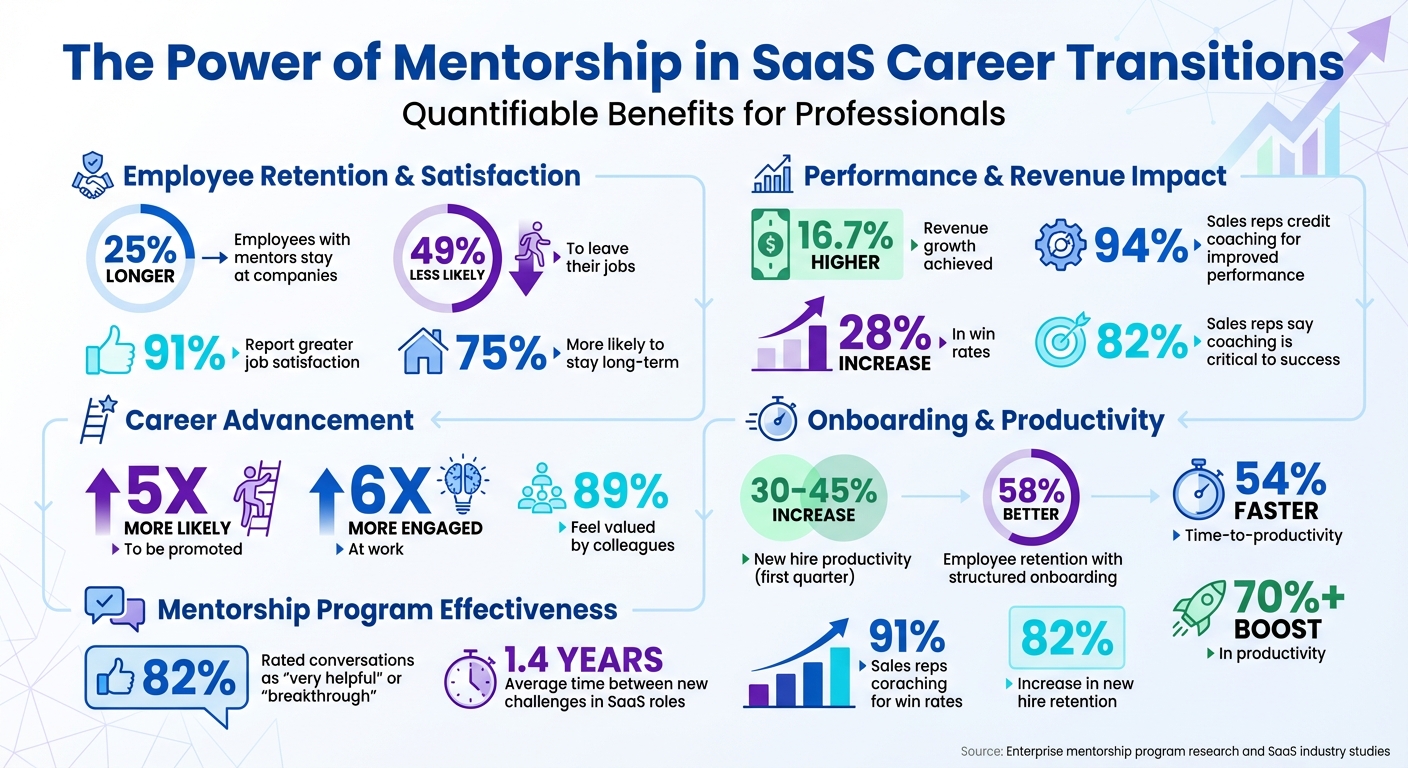
Impact of Mentorship on SaaS Career Transitions: Key Statistics
Solution Advisor Shares The Impact of Mentorship in Tech | Kirk Taylor
How Mentors Evaluate Readiness for New Roles
Before someone in SaaS transitions to a new role, mentors take a deep dive into evaluating their readiness. This goes well beyond just ticking off technical skills. Mentors focus on transferable abilities like communication, problem-solving, and leadership - qualities that can be applied across various SaaS roles. They also analyze metrics such as win rates, average selling prices, and revenue growth to gauge if the individual is ready for more responsibility.
But it’s not just about numbers. Mentors pay close attention to behaviors that indicate success, such as professional presence, resilience when deals don’t go as planned, and the ability to handle objections or rejection. Career expert Corean C highlights why this is essential:
Many times, we can't read the label to our own jars from the inside. We can have so many blindspots to our own skill sets or how to really articulate our impact. That's why it's important to have mirrors.
This balanced approach - combining measurable results with behavioral insights - helps mentors identify where skill gaps exist.
Identifying Skills Gaps
Once readiness is assessed, mentors use tools like SWOT analysis (Strengths, Weaknesses, Opportunities, Threats) and skill inventories to zero in on what’s missing. For SaaS-specific transitions, this often includes evaluating product knowledge and understanding of industry trends.
Motivational interviewing is another method mentors use to uncover hidden skills. Dr. Shawnte Elbert, a consultant in organizational leadership, explains her approach:
When I am working with my mentees, having them write down their skills can be challenging if they minimize them so we often have 'open conversations' where I use motivational interviewing to dive deeper into the skill or scenario.
Mentors also use a skills alignment matrix to directly map current abilities to the demands of the new role. For example, project management experience might translate into operations management, while data analysis skills could be leveraged in business intelligence roles. In sales, mentors might review call recordings or set up shadowing sessions with top performers to identify gaps in areas like objection handling or discovery techniques. This process naturally leads to creating targeted development plans.
Creating Individual Development Plans (IDPs)
Once the gaps are clear, mentors work on a roadmap to close them. A strong Individual Development Plan (IDP) often starts with a 360-degree assessment, gathering feedback from colleagues, managers, and direct reports to uncover blind spots the mentee might not notice. From there, mentors help set SMART goals (Specific, Measurable, Attainable, Relevant, Time-bound). Examples include transitioning from a BDR to an AE role within nine months or mastering enterprise account management by the end of the year.
The most effective IDPs break big goals into smaller, actionable steps. These might include earning certifications like MEDDICC, shadowing a Senior AE on discovery calls, or leading a small cross-functional project. Mentors also recommend specific training programs, networking opportunities, and templates they’ve found helpful in their own careers.
To ensure progress, mentors establish clear success metrics, such as achieving a specific quota percentage or closing a set number of enterprise deals. Regular check-ins - monthly or quarterly - help keep the plan on track and allow for adjustments as the mentee grows in their career.
How Mentors Build Skills During Transitions
When professionals transition into new SaaS roles, breaking down skill-building into clear phases helps them adapt more effectively. Mentors typically guide this process across three stages: mastering the basics, tackling advanced strategies, and developing cross-functional skills. This phased approach ensures mentees can grow steadily without feeling overwhelmed.
Basic Training
The first step focuses on understanding the fundamentals of the SaaS business model. Mentors emphasize the importance of subscription-based revenue, where recurring income takes precedence over one-time sales. Key metrics like Monthly Recurring Revenue (MRR), Annual Recurring Revenue (ARR), Customer Acquisition Cost (CAC), and Churn Rate are introduced as critical benchmarks for success. Companies with structured onboarding programs often report 58% better employee retention and 54% faster time-to-productivity, which highlights why these basics are taught early on.
To make these concepts practical, mentors analyze real customer behaviors, exploring what drives purchasing decisions and what challenges customers face daily. Mock demos and pitch sessions are used to connect SaaS product features to customer needs. Additionally, mentees are trained on essential tools like Salesforce or HubSpot through structured plans, often mapped out over 30, 60, and 90 days.
Once these foundational skills are solid, the focus shifts to role-specific strategies.
Advanced Tactics for Success
The second phase zeroes in on the unique demands of specific SaaS roles. For sales professionals, this involves moving beyond generic techniques like objection handling to mastering strategies tailored to the company’s challenges. Mentors help mentees develop quick, adaptable thinking for navigating complex sales scenarios.
For those in Customer Success, the emphasis shifts from reactive problem-solving to proactive value creation. Mentors teach how to use data, such as usage analytics, to identify at-risk accounts and initiate meaningful conversations before renewal periods. Meanwhile, in marketing, the focus pivots from broad demographic profiling to creating behavioral Ideal Customer Profiles (ICPs), which provide deeper insights into how customers make purchasing decisions. Research shows that this kind of targeted coaching can lead to a 16.7% increase in annual revenue growth and a 28% rise in win rates.
With advanced strategies in place, mentors then broaden the mentee’s perspective through cross-functional learning.
Cross-Functional Skills Development
In the final stage, mentors encourage mentees to step outside their core roles and gain insights into how other teams operate. Shadowing adjacent functions, such as marketing or product development, helps mentees understand how different teams contribute to overall success. For instance, at Mailchimp, GTM (Go-To-Market) leaders often participate in both marketing and product meetings to see how campaigns and engineering efforts align.
Mentors also help transform specialized knowledge into actionable frameworks for the organization. At Snowflake, for example, early sales successes were turned into detailed playbooks, enabling teams across the company to replicate winning strategies. As GTM leader Joshua Zerkel puts it:
Depth creates credibility. Breadth creates alignment. The most effective GTM leaders learn to balance both, by using community as the bridge.
For sales and Customer Success professionals, volunteering for product beta testing is another way to build cross-functional relationships, particularly with Product Managers. This exposure ensures mentees are well-equipped to collaborate across teams as they settle into their roles.
Building Networks and Fitting into Company Culture
Mentors do more than just help mentees sharpen their technical skills. They play a crucial role in helping newcomers navigate the professional landscape and understand the subtle, often unspoken rules that define how things truly operate in a SaaS role. This includes fostering connections and providing insights into company culture.
Making Professional Connections
Mentors act as bridges, connecting mentees with key stakeholders across departments and roles. Alex Webb, Director of Engineering at CB Insights, explains:
Mentors will make introductions, recommend relevant Slack channels, and serve as another dedicated point of contact to offer guidance.
These introductions help mentees identify collaborators and build support networks.
The benefits don’t stop at internal connections. Himankini, a Product Manager at Meta, highlights how mentors can expand professional horizons:
Your PM mentor can provide you with networking opportunities by giving you access to a broader professional network.
These external connections can offer fresh perspectives and valuable industry insights. Statistics back this up: employees with mentors are 49% less likely to leave their jobs, and 89% report feeling valued by their colleagues.
Mentors also share strategies for gaining visibility across teams. For instance, cross-functional shadowing - like a new sales hire sitting in on a product demo - helps mentees understand the customer journey and spot collaboration opportunities. In one enterprise mentorship program, 82% of participants rated their mentoring conversations as either "very helpful" or a "breakthrough".
By building these networks, mentees not only gain professional support but also set the stage for understanding and integrating into their company's culture.
Adapting to Company Culture
Company culture is more than a set of policies or an employee handbook. Mentors act as "cultural translators", helping mentees decode the political dynamics, norms, and practical shortcuts that only experience can reveal. Dominic Monn, CEO of MentorCruise, puts it this way:
A mentor accelerates onboarding because they provide context that no training manual or orientation session can offer. They help you understand the unwritten rules, the political dynamics, the shortcuts that only come from experience.
This guidance is particularly important during the first 90 days. Many mentors use the 5 C’s framework - Compliance, Clarification, Culture, Connection, and Check-back - to ensure mentees grasp not just what to do, but how to do it effectively. Elizabeth Salazar, Senior Engineering Manager at Thirty Madison, adds:
We've created a warm, supportive atmosphere that has allowed us to onboard new colleagues into that culture quickly and ensure they follow the same practice of empathy as we grow even more.
The numbers speak for themselves: structured onboarding programs can increase new hire retention by 82% and boost productivity by more than 70%. When combined with strong professional networks, these cultural insights give mentees the tools they need to confidently navigate their new roles in SaaS environments.
Long-Term Support Mentors Provide After Transitions
The early stages of mentorship are crucial, but it's the ongoing support that truly drives long-term success. This sustained guidance builds on initial skills and helps mentees maximize their networks and opportunities for continued growth.
Regular Check-Ins and Feedback
Consistent, focused check-ins are essential for maintaining accountability and tracking progress. Most mentors opt for biweekly 1-on-1 sessions lasting about 45 minutes, which are used to assess achievements, address challenges, and set new goals.
Between these formal sessions, mentors often provide "laser coaching" through quick calls or emails to tackle urgent issues as they arise. This on-demand support ensures that small problems don't escalate into larger obstacles. The results speak for themselves: 82% of sales representatives credit coaching as a critical factor in their success, and 94% say it directly improves their performance.
Performance-focused feedback makes these check-ins especially impactful. By analyzing CRM data - such as connect rates and SQL conversions - mentors can pinpoint specific areas where mentees can improve.
"Having a mentor while transitioning into a new role really helped me get settled quickly. I felt confident and empowered to hit the ground running, and my sessions helped me create clear objectives and priorities within my new job".
To ensure every session is productive, mentors often require mentees to submit a concise agenda in advance. This typically includes a one-sentence summary of the context and a specific blocker they need help with, submitted at least 24 hours before the meeting. This approach keeps discussions focused and actionable, avoiding vague or unproductive conversations.
Beyond these regular interactions, mentors also provide valuable tools to help mentees succeed.
Access to Resources and Best Practices
While check-ins keep the momentum going, mentors also equip mentees with resources designed to support advanced growth. These include sales playbooks, objection-handling guides, and value-based messaging frameworks tailored to their roles. For instance, mentors might share ROI calculators, case studies, or personalized value propositions to help mentees navigate complex enterprise-level deals.
Mentors also educate mentees on key SaaS metrics - such as Monthly Recurring Revenue (MRR), Annual Recurring Revenue (ARR), Customer Lifetime Value (CLTV), and churn rates - so they can evaluate business performance from a strategic perspective. They often introduce best practices like the "80/20 Pareto Principle", encouraging mentees to focus on the 20% of software features that deliver 80% of the value to customers.
The benefits of mentorship are clear: mentored employees are 5 times more likely to be promoted and 6 times more engaged. Furthermore, 75% of employees with mentors are more likely to stay with their companies for the long haul. By offering this ongoing support, mentors help turn a successful role transition into a foundation for sustained career growth.
How Stackd Supports SaaS Role Transitions Through Mentorship
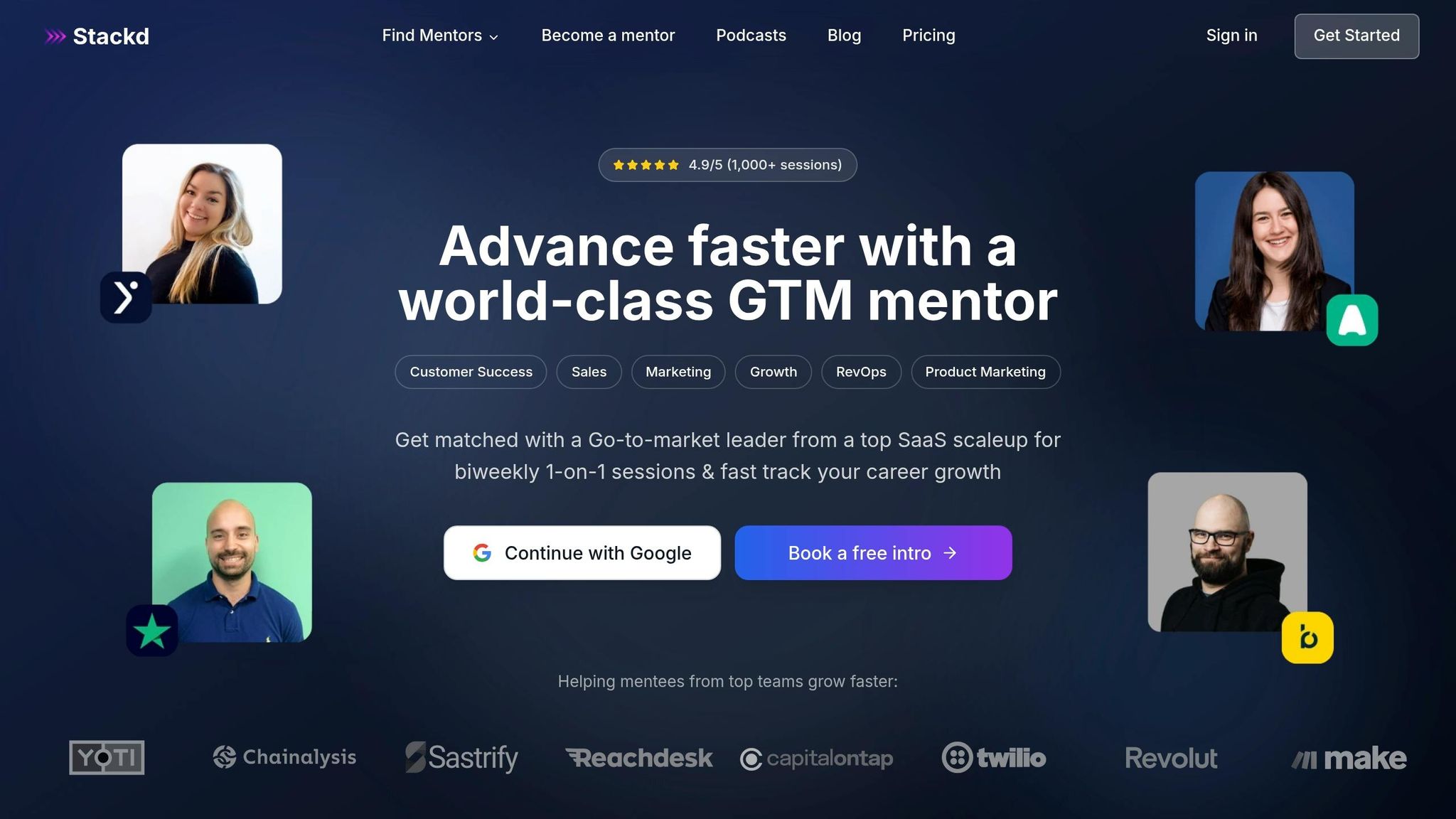
Stackd provides tailored mentorship to SaaS professionals navigating career transitions, connecting Go-to-Market professionals with experienced leaders from top companies like Deel, Salesforce, and Google. Matches are based on career goals, language preferences, and market expertise, ensuring guidance is both relevant and actionable.
Key Features and Benefits
The platform offers biweekly 45-minute sessions, designed to address immediate challenges while helping mentees develop long-term skills. A dedicated Stackd account manager ensures sessions run smoothly and supports ongoing professional growth.
One standout feature is the unlimited mentor re-matching option. If the initial pairing doesn't feel right, users can switch mentors at no extra cost. This flexibility is especially helpful for professionals facing unique challenges, such as transitioning from a BDR to an AE role or stepping into a Customer Success Manager position. By allowing mentees to adjust their mentorship as their needs evolve, Stackd ensures a better fit and more effective guidance.
These features create a supportive environment for professionals to achieve meaningful career progress during their transitions.
Success Stories and Use Cases
Stackd’s mentorship has helped professionals achieve significant milestones across roles like Sales, Customer Success, Marketing, Growth, RevOps, and Product Marketing.
For example, those stepping into Customer Success Manager roles have received strategic advice on building strong customer relationships, managing renewals, and driving expansion revenue. Employees aiming for promotions within their current organizations have also benefited from mentorship focused on skill development and career positioning.
New users can explore the platform with a free 30-minute trial session. The $60/month plan includes two 45-minute sessions, offering an affordable way to access expert guidance tailored to their career journey.
Conclusion
Navigating role transitions in SaaS demands a mix of technical know-how and a forward-thinking approach. Mentors play a crucial role in this process by helping mentees pinpoint skill gaps, adapt their current expertise to new roles, and build the confidence needed to face unfamiliar challenges.
The impact of mentorship is clear. Studies show that coaching boosts sales reps' performance by 94%, increases new hire productivity by 30–45% within the first quarter, and encourages mentored employees to stay 25% longer, with 91% reporting greater job satisfaction.
"Traditional sales training teaches you what to say. A sales mentor shows you how to think." - Elay Cohen, CEO, SalesHood
A strong mentorship program provides a safe environment to tackle difficult scenarios, broadens professional networks, and uncovers areas for improvement. Mentors help mentees set clear goals, break large objectives into manageable steps, and craft development plans that align with their career ambitions. This approach not only addresses skill gaps but also fosters continuous professional growth.
Whether shifting from BDR to AE, moving into Customer Success, or stepping into leadership, the guidance of a skilled mentor transforms challenges into opportunities for rapid progress. Personalized advice, structured support, and practical insights make career transitions less intimidating and far more rewarding.
FAQs
How do I know I’m ready for a new SaaS role?
If you're considering a new SaaS role, it might be time to make the leap when you can show clear progress in your current position. This could mean improved KPIs, a solid track record of results, and confidence in your ability to apply your skills to new challenges. Feeling ready to take on more responsibility is another strong indicator. Plus, feedback from trusted mentors or managers can offer valuable insight into whether you're prepared to take the next step.
What should an Individual Development Plan (IDP) include?
An Individual Development Plan (IDP) serves as a roadmap for personal and professional growth. It should include specific development goals, practical steps to achieve those goals, and a clear timeline. To make it effective, the plan must align with both the individual’s career aspirations and the organization’s objectives. By focusing on measurable progress and tangible behavior changes, an IDP ensures that growth is not just theoretical but can be tracked and translated into real-world results.
How can a mentor help me navigate company culture fast?
A mentor can help you navigate the ins and outs of your workplace by offering valuable insights into the organization’s dynamics, values, and expectations. They can shed light on those unwritten rules that aren’t in the handbook, guide you in aligning with team practices, and make it easier to adjust to your new environment.