
Top 7 Traits Of Great GTM Mentors
Top 7 Traits Of Great GTM Mentors
The right mentor can transform your SaaS career. GTM mentors bring expertise in SaaS strategies, cross-functional leadership, and data-driven decision-making to help you grow. They guide you through challenges like complex sales cycles, customer retention, and team alignment. Here are the seven traits that define the best GTM mentors:
- SaaS Expertise: Deep knowledge of metrics like MRR, LTV, and strategies like PLG or ABM.
- Lifecycle Management: Understanding every stage, from lead generation to renewals.
- Cross-Functional Leadership: Aligning sales, marketing, product, and customer success teams.
- Data-Driven Insights: Focus on metrics like CAC, NRR, and pipeline velocity.
- Customer-Centric Approach: Building trust and long-term relationships with customers.
- Sales & Marketing Integration: Uniting teams for shared revenue goals.
- Team-Building Skills: Empowering mentees to lead and inspire their teams.
These traits are essential for navigating SaaS challenges and accelerating your career. Platforms like Stackd make finding such mentors easy, connecting you with SaaS leaders for tailored guidance.
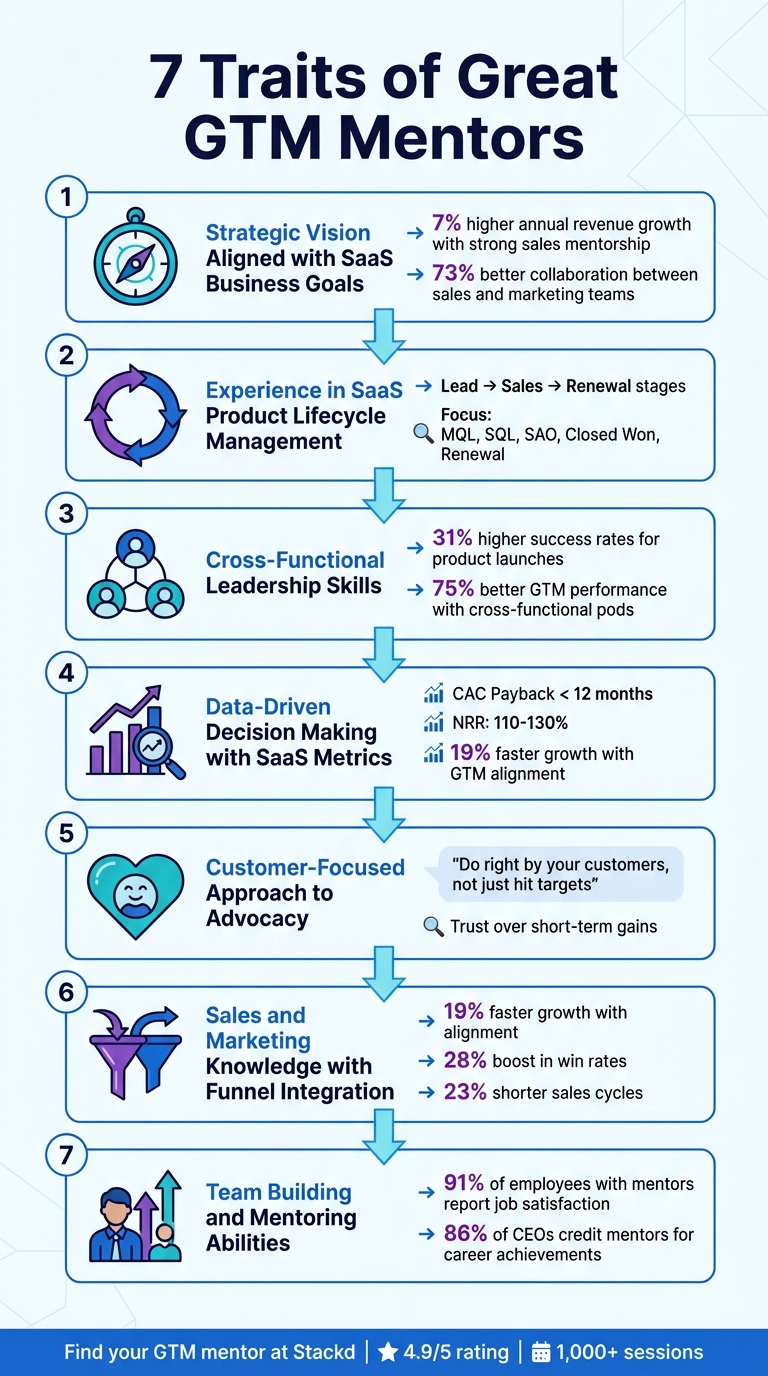
7 Essential Traits of Great GTM Mentors in SaaS
1. Strategic Vision Aligned with SaaS Business Goals
SaaS Industry Expertise
A top GTM mentor knows the importance of key metrics like Monthly Recurring Revenue (MRR) and Lifetime Value (LTV). They guide you in choosing strategies such as Product-Led Growth (PLG) or Account-Based Marketing (ABM) in a way that aligns with your SaaS goals. Rather than relying on assumptions, they help you build a tiered Ideal Customer Profile (ICP) based on real deal data and behavioral signals. This expertise can drive real results - companies with strong sales mentorship programs experience 7% higher annual revenue growth, and in some cases, growth can jump by 25% to 40% thanks to increased leads and better win rates.
But technical know-how alone isn’t enough. A great mentor also knows how to bring diverse teams together to execute a unified strategy.
Cross-Functional Leadership and Communication
Even the best strategies fall flat if your teams - sales, marketing, product, and customer success - aren’t working toward the same goals. Top GTM mentors break down these silos, ensuring every department is aligned on shared revenue objectives. Acting as a bridge, they translate customer feedback into actionable insights, shaping product roadmaps and ensuring the company delivers on its promises.
"Your customers don't differentiate between departments; they see your company as one." - Chris Moody, Former Chief Evangelist, Marketing, Demandbase
The results of this alignment speak for themselves. Companies using integrated GTM strategies report 73% better collaboration between sales and marketing teams, and unified approaches have driven up to a 125% increase in net revenue retention (NRR). A mentor also helps define shared criteria for funnel stages - clarifying what makes a lead an MQL versus SQL - so the entire team works seamlessly without unnecessary friction.
Once alignment is achieved, the focus shifts to leveraging data for continuous improvement.
Data-Driven Decision-Making Capabilities
Great mentors emphasize solving the right problems before jumping to solutions. As Micah Moreau, VP of Growth Marketing at DoorDash, explains:
"Nine times out of 10 the issue isn't about finding the optimal solution, but rather ensuring people are focused on the right problem in the first place."
Using tools like reverse funnel math, they help you set precise pipeline generation targets based on your sales cycles and win rates. They also guide you in crafting messaging that addresses the most urgent pain points for decision-makers. This data-first approach not only reduces Customer Acquisition Cost (CAC) but also accelerates lead velocity, creating a repeatable and scalable revenue engine.
Customer-Focused Strategies
In SaaS, success isn’t just about closing the first deal - it’s about delivering ongoing value throughout the customer lifecycle. A strategic mentor ensures you focus on continuous value delivery, which is the foundation of recurring revenue. By establishing feedback loops - drawing insights from support tickets and user interviews - they help you refine both your GTM strategies and product roadmap.
Beyond immediate tactics, the best mentors help you anticipate challenges on the horizon. As Chris Hicken, CEO and co-founder of 'nuffsaid, explains:
"Mentors who are much further ahead in their careers... can help you peer around corners that you don't even see coming."
This forward-thinking approach ensures your team prioritizes activities that drive long-term growth and align with your broader business objectives.
2. Experience in SaaS Product Lifecycle Management
When selecting a GTM mentor, their expertise in managing the SaaS product lifecycle is a crucial factor for meaningful career growth. The best mentors understand every stage of the SaaS lifecycle, from Lead stages (MQL, SAL, SQL) to Sales stages (SAO, Evaluation, Proposal, Closed Won), and finally, Renewal stages (Renewal, Negotiation).
"A SaaS GTM strategy is different because the business model is different. Instead of a one-time purchase, SaaS companies rely on recurring revenue. This shifts the focus to metrics like customer lifetime value (LTV), monthly recurring revenue (MRR), and low churn." - Amplitude
The most effective mentors excel at navigating the "Golden Stages" - key milestones like early adoption, achieving the first Time-to-Value (TTV) event, converting leads into SQLs, and closing deals. For instance, Slack’s freemium model and user-friendly onboarding process allowed teams to transition seamlessly from initial use to full adoption. This kind of lifecycle expertise sets apart mentors who can offer actionable, growth-focused guidance from those who provide generalized advice.
A mentor with this depth of knowledge can also foster collaboration across departments to ensure cohesive execution.
Cross-Functional Leadership and Communication
Managing the SaaS lifecycle effectively demands alignment across marketing, sales, product, and customer success teams. A mentor with hands-on experience in these areas can help resolve interdepartmental issues and establish clear Service Level Agreements. They also define key conversion benchmarks, such as maintaining an MQL-to-SQL rate above 15% and a demo-to-trial conversion rate exceeding 30%, to reduce inefficiencies.
"The GTM lifecycle isn't just about sales stages, but also about marketing, customer success, and implementation teams." - LeanScale
This isn't just theory - it’s a practical approach. When all departments operate from a unified framework, efforts are streamlined, and successful strategies can be scaled more effectively.
This alignment naturally supports the creation of a seamless customer experience.
Customer-Focused Strategies
Mentors with a strong grasp of lifecycle management understand that onboarding and early adoption are critical moments that can determine success or failure. They focus on designing smooth onboarding processes that mitigate early churn.
At the renewal stage, experienced mentors ensure you're tracking essential metrics like maintaining a Customer Acquisition Cost (CAC) payback period of under 12 months. They also emphasize monitoring conversion rates throughout the funnel. Their guidance helps you build systems that not only attract customers but also retain them, turning initial buyers into long-term revenue contributors.
Platforms like Stackd connect you with mentors who possess this hands-on SaaS lifecycle expertise, equipping you with the tools to thrive in GTM roles. This kind of lifecycle knowledge complements broader GTM mentoring skills, laying the groundwork for sustained career progression.
3. Cross-Functional Leadership Skills
Exceptional mentors know how to unite teams across different departments, ensuring everyone works together toward shared goals. In Go-to-Market (GTM) strategies, this means bridging gaps between sales, marketing, product, and customer success teams. These mentors focus on developing what’s known as T-shaped talent - individuals who have deep expertise in one area but also possess a broad understanding of other disciplines. This combination helps break down silos that often disrupt strategy and execution.
"Cross-functional collaboration is vital for a successful GTM strategy. By fostering effective teamwork between departments such as product, marketing, and sales, businesses can develop a well-rounded approach that accelerates growth." - Richard Flynn, Founding Partner and CMO, Spur Reply
The results of this leadership approach are clear. Companies that prioritize cross-functional collaboration during GTM planning report 31% higher success rates for product launches. Meanwhile, teams organized into "pods" - small, cross-functional groups - achieve 75% better GTM performance. These aren’t minor gains; they’re the difference between a product thriving in the market or fading into obscurity.
This leadership style also lays the groundwork for a strong, empathetic team culture. Effective mentors lead alignment sessions that bring all GTM stakeholders together, ensuring smooth communication and eliminating bottlenecks between departments. By cultivating T-shaped talent, they help teams stay agile and better equipped to handle the complexities of GTM initiatives.
Beyond alignment, great mentors emphasize creating psychological safety within their teams. They lead with empathy, fostering trust and cohesion, which is especially important in high-pressure SaaS environments. This approach not only reduces turnover but also strengthens team performance. It’s worth noting that 92% of hiring managers now consider soft skills like communication and collaboration more critical than ever in GTM roles. A mentor who demonstrates these qualities prepares you to lead teams effectively, equipping you with the tools to drive results and sustain growth in even the most challenging GTM landscapes.
4. Data-Driven Decision Making with SaaS Metrics
Data-driven decision-making capabilities
Refining your go-to-market (GTM) approach requires more than intuition; it demands a deep understanding of the numbers that shape success. In today's competitive landscape, it's not about doing more - it's about measuring smarter and investing wisely.
"Volume doesn't win. Velocity does." - GTMonday by GTM Partners
The best GTM mentors focus on pipeline velocity instead of simply chasing lead volume. For acquisition, they emphasize the importance of metrics like a CAC Payback Period under 12 months and a Magic Number of 1.0 or higher as signs of efficient growth. When it comes to retention and expansion, Net Revenue Retention (NRR) takes center stage, with top SaaS companies typically achieving NRR benchmarks of 110–130% or more.
A skilled mentor doesn't just share numbers - they help you understand their context. For instance, hybrid pricing models can result in approximately 105% NRR. Additionally, for companies surpassing $50M in annual recurring revenue (ARR), 60% of new revenue often comes from existing customers. Mentors can also guide you in auditing your pipeline, prioritizing velocity over activity. They recommend setting up automated alerts for deal slippage, noting that deals delayed by more than two months can cause win rates to drop by over 100%. Leveraging AI-driven pipeline prioritization, teams often achieve 15–20% higher forecast accuracy and 30% faster conversion rates.
Another critical role of a mentor is helping your organization establish a single source of truth. By aligning on shared definitions for pipeline stages, companies with strong GTM alignment can grow 19% faster and achieve 15% higher profitability. With their guidance, metrics are tied to real outcomes, turning raw data into measurable customer value and expansion opportunities.
Platforms like Stackd are invaluable for connecting with seasoned GTM mentors. If you're looking to master data-driven strategies and scale your career, Stackd offers access to experts who can help you harness the power of metrics to drive meaningful growth.
5. Customer-Focused Approach to Advocacy
Customer-focused strategies
The most effective GTM mentors know that creating customer advocates starts with prioritizing trust over short-term gains. This mindset aligns with a strategic vision and data-informed decisions by keeping the focus on building lasting relationships. Instead of pushing products to meet immediate goals, they teach mentees to concentrate on doing what’s best for the customer.
"At the end of the day, it's important to do right by your customers, instead of aggressively selling them products/services simply to hit your own targets." - Will Cannon, Founder, UpLead
These mentors emphasize the importance of deeply understanding your customers to deliver value at every interaction. They also introduce the idea of a consultative "no" - declining a customer request when it doesn’t lead to meaningful outcomes. This approach not only earns trust but also positions you as a reliable advisor.
Every customer touchpoint should offer something worthwhile, whether it’s a product update, an industry trend, or a relevant case study. Mentors stress that consistently sharing useful insights strengthens the relationship and enhances the customer experience.
This customer-centered approach delivers tangible results. Companies that make customer advocacy a core part of their GTM strategy often see improved retention rates and increased lifetime value. For those eager to develop these skills, platforms like Stackd connect you with seasoned GTM leaders who have successfully implemented customer-first strategies on a large scale.
Focusing on the customer creates a strong foundation for mastering the next crucial GTM mentor quality.
6. Sales and Marketing Knowledge with Funnel Integration
Expert mentors do more than just shape strategy and manage lifecycles - they bring sales and marketing together through thoughtful funnel integration.
Cross-Functional Leadership and Communication
Great GTM mentors know that sales and marketing thrive when they operate as a team. They push companies to move past outdated, siloed lead generation models and adopt a unified approach where both departments collaborate to hit shared revenue targets. The results are hard to ignore: businesses with strong alignment grow 19% faster, cut sales cycles by 23%, and see a 28% boost in win rates. On the flip side, poor alignment can lead to losing up to 30% of qualified leads before a sales rep even makes contact.
Mentors often recommend setting up GTM councils - cross-functional teams that meet regularly to align on key metrics like pipeline performance, retention rates, and messaging strategies. They also advocate for shared dashboards that track crucial KPIs such as revenue and Net Revenue Retention.
"Alignment doesn't happen by chance; it happens by design." - Mina, B2B SaaS Product Marketing Expert
Once teams are aligned, the focus shifts to using data to fine-tune every stage of the funnel.
Data-Driven Decision-Making Capabilities
Leading GTM mentors highlight the importance of omnichannel outreach. Since 80% of deals require at least five touchpoints but 44% of sales reps give up after just one, a coordinated approach - combining LinkedIn, email, phone calls, and ads - proves more effective. In fact, 94% of B2B decision-makers prefer this kind of blended strategy.
Mentors also emphasize the value of strategic discovery conversations. Research shows that asking 11–14 targeted questions can increase close rates by 74%, while diving into specific business challenges with at least three well-chosen questions boosts win rates by 37%. This approach ensures that messaging stays consistent across marketing, sales, and onboarding efforts, all while keeping the focus on solving real business problems.
For professionals ready to dive into these strategies, Stackd offers access to experienced GTM leaders who’ve built scalable, cross-functional systems. With a stellar 4.9/5 rating across more than 1,000 sessions, Stackd provides actionable advice that turns funnel integration into tangible outcomes.
7. Team Building and Mentoring Abilities
Great GTM mentors don’t just focus on strategy and collaboration - they’re also dedicated to shaping leadership skills that help teams thrive. They aim to empower mentees with the tools to not only manage but inspire their teams, blending technical know-how with the interpersonal skills that define strong leaders.
Cross-Functional Leadership and Communication
One hallmark of effective mentorship is helping mentees build connections across departments. By introducing them to key colleagues and opening doors to new opportunities, mentors expand their mentees’ internal networks. This is particularly critical in SaaS, where seamless collaboration between product development, marketing, sales, and customer success is essential for sustaining revenue and retaining customers.
The numbers back this up: 91% of employees with mentors report job satisfaction, while 86% of CEOs credit mentors for their career achievements.
"Stackd mentorship has been a game-changer for myself and I see my role with a much wider perspective now." - Josh Hardy, Account Executive, Azarc
But mentorship isn’t just about external connections. Great mentors also help mentees strengthen their personal leadership skills, starting with the art of listening.
Active Listening and Inquiry
Strong mentors lead by example, demonstrating active listening and encouraging mentees to think critically by asking thoughtful questions rather than handing out solutions. This approach sharpens problem-solving abilities and equips mentees to guide their own teams effectively.
Mentors also build trust by sharing their own challenges and missteps in areas like cross-functional collaboration or team management. By being open about their experiences, they create a safe learning environment where mentees feel encouraged to reflect and grow.
This combination of networking, listening, and transparency not only builds stronger teams but also prepares mentees to step confidently into leadership roles.
For professionals eager to strengthen these skills, platforms like Stackd offer access to seasoned GTM leaders from companies like Deel, Anaplan, and Salesloft. With a stellar 4.9/5 rating across over 1,000 sessions and a 96% match success rate, Stackd provides mentees with actionable insights from leaders who’ve faced similar challenges. At just $60/month for two 45-minute sessions, it’s an affordable way to gain fresh perspectives and refine leadership abilities.
Conclusion
Choosing the right GTM mentor can mean the difference between feeling stuck and achieving real career momentum. The seven traits we outlined - strategic vision, SaaS lifecycle expertise, cross-functional leadership, data-driven thinking, customer focus, sales and marketing knowledge, and team-building - are what separate impactful mentors from those offering surface-level advice. These traits are the foundation of mentorship that delivers practical, role-specific guidance.
The benefits of these qualities go beyond theory. Research shows that effective mentorship directly leads to higher job satisfaction, faster revenue growth, and better employee retention. For mentees, this often translates into quicker promotions, higher salaries, and a deeper sense of fulfillment in their careers.
"A skilled mentor helps others 'see something that they didn't even know was possible inside themselves.'" - Nancy Girres, Executive Coach
Finding a mentor with these traits can be challenging. Traditional networking can take months or even years to yield results, and there’s no guarantee the mentor you connect with will have the up-to-date expertise or niche knowledge you’re looking for.
That’s where Stackd can help. Stackd connects you with experienced SaaS leaders for tailored 1-on-1 mentorship sessions. With a 96% success rate in matching mentees with mentors and a 4.9/5 average rating across more than 1,000 sessions, it’s a platform designed to fast-track your career growth. For $60/month, you’ll get two 45-minute sessions, and the free trial makes it easy to get started. Whether you’re looking to sharpen your strategic thinking, expand your technical skills, or develop as a leader, the right mentor is closer than you think. The real question is: how soon will you take the next step?
FAQs
How do I know if a GTM mentor is a good fit for my role?
A great GTM mentor stands out by communicating clearly, sharing extensive industry expertise, and genuinely investing in your success. The right mentor will offer personalized guidance, help you foresee potential hurdles, and deliver practical advice that aligns with your long-term objectives.
Which SaaS metrics should my mentor help me prioritize first?
A mentor plays a crucial role in helping you focus on the right SaaS metrics that align with your go-to-market (GTM) strategy. It's essential to zero in on KPIs (Key Performance Indicators) and OKRs (Objectives and Key Results) that provide clarity and keep the team aligned. These metrics also allow for quick course corrections when needed.
One key takeaway? Prioritize leading indicators over lagging results. Leading indicators, such as customer acquisition rates or trial-to-paid conversion rates, offer early insights and help you stay proactive. This approach is especially important when you're planning for future goals, like initiatives set for 2026. By focusing on what drives success today, you'll be better prepared for tomorrow.
What should I bring to a GTM mentoring session to get results?
To get the most out of a GTM mentoring session, it's important to show up prepared. Start by setting clear goals and outlining specific questions about the challenges or opportunities you're facing. Provide your mentor with relevant details about your current projects, the industry you're working in, and any supporting data or metrics you have.
Being open to feedback and ready to discuss both your aspirations and obstacles allows your mentor to offer guidance that's tailored to your situation. This approach can lead to a more productive and insightful session.